
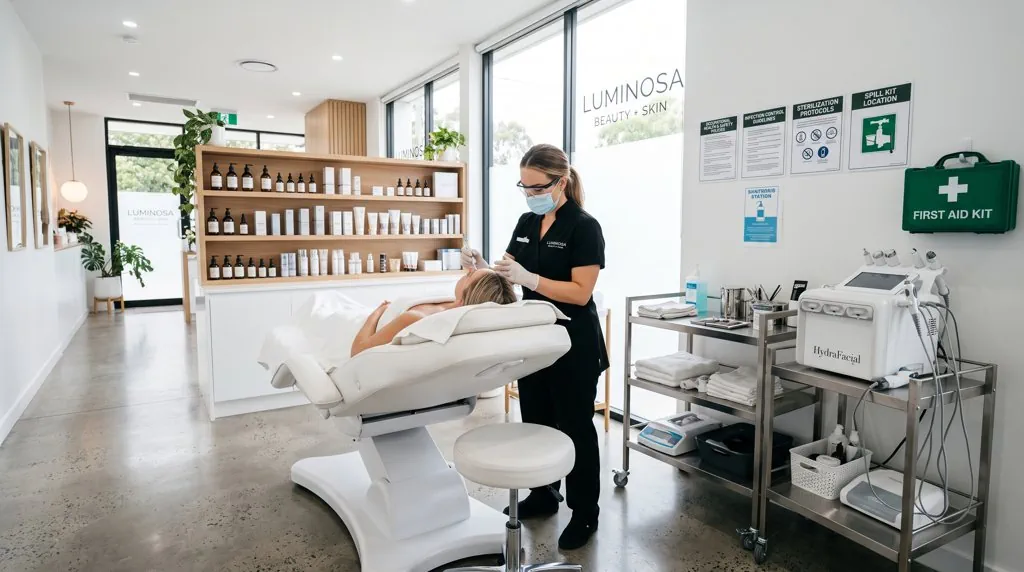
Common Hazards in a Beauty Salon – 2026 Guide/Workbook
An Australian WHS & Safety Guide for Salons and Clinics 2026
Beauty salons and clinics may look calm from the treatment room, but behind every appointment is a workplace containing chemicals, electrical equipment, sharp instruments, repetitive physical tasks, infection risks and, increasingly, sophisticated beauty devices.
That makes workplace safety much more than keeping the floor dry and the treatment room clean.
For Australian beauty business owners, effective risk management means identifying what could cause harm, assessing the risks, implementing appropriate controls and regularly reviewing whether those controls are working.
Safe Work Australia describes risk management as an ongoing process of identifying hazards, assessing risks where necessary, controlling those risks and reviewing controls.
Safe Work Australia – Identify, Assess and Control Hazards
And as the beauty industry evolves, the hazards are evolving too.
Here are some of the most important risks salon and clinic owners should be considering.
1. Infection and Cross-Contamination
Infection prevention is one of the most important areas of risk management in beauty services.
Depending on the treatments performed, workers and clients may potentially be exposed to blood, body substances, contaminated instruments, surfaces or equipment.
Risk can increase when treatments penetrate the skin.
Good infection-control procedures may include appropriate hand hygiene, correct use of personal protective equipment, cleaning treatment surfaces between clients, correct management of single-use items, safe handling of contaminated materials and appropriate reprocessing of reusable instruments.
Importantly, cleaning, disinfection and sterilisation are not interchangeable terms.
The level of reprocessing required depends on the instrument, how it is used and the infection risk associated with that use.
Queensland Health, for example, currently provides specific guidance for personal appearance services and reprocessing reusable instruments, including reference to AS 5369:2023.
Queensland Health – Personal Appearance Services Compliance Resources
Queensland businesses can also refer to:
Queensland Health – Infection Control Guidelines for Personal Appearance Services
Businesses in other states and territories should check the requirements applying in their own jurisdiction.
ABA Expert Tip
Don’t rely on staff simply “knowing how we clean things here.”
Document infection-control procedures and incorporate them into induction, training and competency reviews.
2. Sharps and Skin-Penetration Injuries
Needles, blades, lancets and other sharp instruments can cause puncture wounds and potentially expose workers to blood-borne infection risks.
Businesses providing relevant services should have clear procedures covering safe handling, storage, use, immediate disposal, suitable sharps containers, exposure management and incident reporting.
Used sharps should never be left sitting unnecessarily on treatment trolleys or carried around the workplace when they can be disposed of safely.
Staff should also know exactly what to do if an exposure occurs.
An emergency procedure sitting unread in a folder isn’t enough.
3. Hazardous Chemicals
Beauty professionals can work with a surprisingly broad range of chemicals.
Depending on the business, these can include:
- Cleaning and disinfecting products
- Nail products
- Adhesives
- Solvents
- Hair colour products
- Lash and brow products
- Chemical exfoliants
- Surface cleaners
- Other salon chemicals
Potential exposure may occur through the skin, eyes or inhalation.
Risk management may involve appropriate ventilation, suitable storage, following manufacturer instructions, staff training and using appropriate PPE where required.
Relevant Safety Data Sheets should also be accessible where workplace hazardous chemical requirements apply.
Safe Work Australia – Hazardous Chemicals
Never transfer a workplace chemical into an unlabelled drink bottle, food container or other container that could create confusion.
4. Poor Ventilation
Ventilation deserves far more attention than it receives in many beauty workplaces.
Some treatments and products can release vapours, aerosols, dust or odours into the working environment.
This may be particularly relevant in businesses providing nail services or using products that generate airborne contaminants.
Opening the front door occasionally should not automatically be considered an adequate ventilation strategy.
Consider the products and procedures actually used in your workplace and whether source extraction, local exhaust ventilation or other controls are appropriate.
5. Slips, Trips and Falls
Sometimes the simplest hazards cause significant injuries.
Common salon risks can include:
- Water around basins
- Product spills
- Electrical cords
- Boxes in walkways
- Towels on floors
- Poorly positioned furniture
- Damaged flooring
- Cluttered treatment areas
Spills should be addressed promptly rather than left for “someone else” to deal with.
Walkways, treatment access areas and emergency exits should also remain clear.
6. Electrical Hazards
Modern beauty businesses can contain dozens of electrical devices.
These might include:
- Facial machines
- LED equipment
- Microcurrent devices
- Hair equipment
- Wax heaters
- Nail equipment
- Computers and POS systems
- Sterilisation or reprocessing equipment
- Laser and IPL systems
- Body-contouring devices
Damaged cables, poorly maintained equipment, inappropriate power arrangements or equipment used outside its intended instructions can create risks including electric shock, burns and fire.
Businesses should maintain equipment appropriately, remove damaged equipment from service and ensure workers are adequately trained to operate the equipment they use.
ABA has further information for salons assessing professional beauty equipment:
ABA – Compliance and Safety Standards for Beauty Equipment in Australia
Salon owners considering direct imports should also read:
ABA – Can I Import Beauty Devices to Use in My Salon in Australia?

7. Laser, IPL and Light-Based Treatment Hazards
Laser and IPL treatments deserve their own safety category.
These technologies can create risks to the client and the person performing the treatment, including optical radiation hazards involving the eyes and skin.
Operators need appropriate training, treatment protocols and safety controls.
Where lasers are used, protective eyewear needs to be suitable for the relevant equipment and exposure conditions.
Importantly, Australia does not currently have one uniform national licensing system for cosmetic laser and IPL treatments.
ARPANSA advises that cosmetic laser use is currently regulated in Queensland, Tasmania and Western Australia. Cosmetic IPL use is specifically regulated in Tasmania, and licensing conditions differ between jurisdictions.
ARPANSA – Advice for Cosmetic Laser, IPL and LED Treatment Providers
Businesses should therefore check the rules applying where they actually operate rather than assuming another state’s requirements apply to them.
8. Burns and Thermal Injuries
Heat-related injuries aren’t limited to laser treatments.
Potential sources can include:
- Wax
- Hot towels
- Steam
- Heated equipment
- Radiofrequency devices
- Light-based equipment
- Other energy-based beauty devices
Controls may include equipment maintenance, appropriate training, temperature checks where relevant, client screening, treatment protocols and following manufacturer instructions.
Staff should also understand what action to take if an adverse event occurs.
9. Manual Handling and Musculoskeletal Injuries
Beauty therapy can be physically demanding.
Therapists may spend hours:
- Standing
- Bending
- Leaning over treatment beds
- Holding awkward positions
- Performing repetitive hand movements
- Reaching
- Moving equipment
Over time, poorly designed work can contribute to musculoskeletal problems.
Consider adjustable treatment beds and stools, workstation layout, equipment positioning, task variation and opportunities for employees to change posture.
Safe Work Australia provides guidance on hazardous manual tasks and the types of work factors that can contribute to musculoskeletal injury.
Safe Work Australia – Hazardous Manual Tasks
A treatment room isn’t well designed simply because it looks beautiful.
It also needs to work for the therapist using it all day.
10. Occupational Skin Exposure
Beauty professionals frequently wash their hands and may regularly come into contact with water, gloves, cleaning agents and cosmetic ingredients.
For some workers, repeated exposure can contribute to occupational skin problems.
Businesses should consider whether exposure can be eliminated or reduced and whether appropriate protective measures are needed.
Persistent skin symptoms should not simply be accepted as “part of working in beauty”.
11. Fire and Emergency Risks
Every beauty business should consider how workers and clients would respond during an emergency.
That includes situations such as:
- Fire
- Electrical incidents
- Medical emergencies
- Chemical exposure
- Serious treatment reactions
- Evacuation
Emergency exits should remain accessible, workers should understand emergency procedures and appropriate emergency equipment should be maintained.
Safe Work Australia provides guidance on workplace emergency planning and first aid.
Safe Work Australia – Emergency Plans and Procedures
Safe Work Australia – First Aid
Remember that beauty clients may be partially undressed, wearing eye protection, receiving a treatment or connected to equipment when an emergency occurs.
Your emergency plan should reflect how your salon actually operates.
12. Psychosocial Hazards
Not every workplace hazard is physical.
Beauty professionals may be exposed to:
- Bullying
- Harassment
- Sexual harassment
- Aggressive clients
- Excessive workloads
- Poor workplace support
- Fatigue
- Role conflict
- Occupational violence or abuse
Psychological health forms part of workplace health and safety.
Safe Work Australia – Psychosocial Hazards
A positive workplace culture is valuable, but posters about teamwork are not a substitute for identifying and managing psychosocial risks.
Salon owners should establish clear behavioural expectations, reporting pathways and processes for addressing workplace concerns.
13. Fatigue and Excessive Workload
Back-to-back treatments may look profitable on the booking system while creating problems elsewhere.
Fatigue can affect concentration, decision-making and treatment performance.
Review whether employees have realistic workloads, appropriate opportunities for rest and sustainable work patterns.
This becomes particularly important when staff operate equipment or perform procedures requiring sustained concentration.
14. Client Aggression and Personal Security
Beauty workers can sometimes work early mornings, late evenings or alone.
Businesses should consider risks associated with:
- Aggressive clients
- Harassment
- Cash handling
- Lone working
- Opening and closing the salon
- After-hours appointments
- Staff leaving the premises at night
Appropriate controls will depend on the business but could include security systems, staffing arrangements, cash-handling procedures, duress arrangements and clear policies covering unacceptable client behaviour.
No employee should be expected to tolerate abuse simply because someone is paying for a service.
15. Beauty Equipment That Isn’t Appropriate for the Intended Use
The beauty equipment market has changed dramatically.
Professional devices can now be purchased directly from overseas manufacturers and online marketplaces.
But being able to buy a machine does not automatically mean it is suitable, compliant or safe for the treatment you intend to provide.
Before introducing equipment, investigate factors such as:
- Intended purpose
- Manufacturer documentation
- Supplier credentials
- Australian regulatory requirements
- Applicable standards
- Staff training
- Maintenance requirements
- Contraindications
- Treatment protocols
- Insurance implications
- State or territory requirements
Not every beauty device is regulated as a medical device, and regulatory requirements can depend heavily on what a particular product is intended and represented to do.
ABA explores this distinction in more detail here:
ABA – Can I Import Beauty Devices to Use in My Salon in Australia?

16. Poor Consultation and Client Screening
Not every hazard comes from the physical workplace.
An inadequate consultation can also create treatment risk.
Depending on the service, consultation processes may need to consider relevant factors such as:
- Medical history
- Medications
- Allergies
- Previous reactions
- Recent treatments
- Contraindications
- Skin condition
- Treatment expectations
- Informed consent
The information required will vary according to the treatment.
A generic form used for every service may not always capture everything relevant to a specialised procedure.
Businesses collecting client health information should also consider their privacy obligations.
Office of the Australian Information Commissioner – Health Information
ABA also has broader guidance on treatment and regulatory boundaries:
ABA – What Compliance Means for Beauty Therapists in Australia
17. Inadequate Staff Training
One of the most important controls in any beauty workplace is competent staff.
Buying a machine and watching a short demonstration does not necessarily establish competency to deliver a treatment safely.
Businesses should consider the knowledge and skills required for each procedure and ensure workers receive appropriate information, instruction, training and supervision.
Training may need to be revisited when:
- New equipment is introduced
- Procedures change
- New products are introduced
- An incident occurs
- Risks change
- A worker needs additional competency development
Documentation also matters.
If your business depends on a therapist being competent to perform a particular treatment, retain appropriate evidence of their training and competency.
The Hierarchy of Controls: Don’t Rely Only on PPE
One of the most important WHS concepts for salon owners to understand is that personal protective equipment should not automatically be the first or only solution.
Risk control generally prioritises eliminating a hazard where reasonably practicable.
If elimination isn’t possible, other controls may include substitution, isolation and engineering controls before relying predominantly on administrative controls and PPE.
Safe Work Australia – Managing Risks and the Hierarchy of Controls
For example, imagine a product is creating irritating fumes.
Providing PPE might form part of the response.
But you should also ask:
Can the product be removed?
Can we substitute a safer product?
Can exposure be isolated?
Can effective extraction or ventilation be installed?
The strongest safety systems control risks at their source wherever reasonably practicable.
Keep a Hazard and Action Register
Identifying a hazard is only the beginning.
Once a risk is found, record:
- What the hazard is
- Who could be harmed
- Existing controls
- Further action required
- Who is responsible
- When action is due
- When the control will be reviewed
The goal is not paperwork for its own sake.
It is accountability.
A hazard register turns:
“We should probably fix that.”
into:
“This is being fixed by this person by this date.”
Worker Consultation Matters
Salon owners and managers do not always see the risks employees experience every day.
Ask your team questions such as:
Is there anything you do here that feels unsafe?
Is there equipment that worries you?
Are there treatments that are physically difficult to perform?
Do you know how to report a hazard or near miss?
Is there anything making your job unnecessarily harder or riskier?
Consulting workers is part of effective WHS risk management.
Safe Work Australia – Managing WHS Risks
Don’t Ignore Near Misses
Imagine a therapist trips over a cable but catches herself before falling.
Nobody was injured.
It would be easy to forget about it.
But the business has just received a warning.
Next time, someone may not catch themselves.
The same principle applies to:
- Equipment almost malfunctioning
- A sharps incident narrowly avoided
- A chemical spill
- A client almost falling
- Incorrect settings caught before treatment
- A worker nearly being burned
Near misses provide an opportunity to fix systems before someone is harmed.
When Should Salon Risks Be Reviewed?
Risk management should be ongoing.
Controls should be reviewed when workplace conditions change or when there is reason to believe existing controls may no longer be effective.
In a beauty business, useful review triggers can include:
- New equipment
- New treatments
- New chemicals
- Renovations
- New staff
- Changed procedures
- Incidents
- Near misses
- Client safety complaints
- Employee discomfort or injuries
- Regulatory changes
Don’t wait for an annual calendar reminder if the workplace has already changed.
Australian Beauty Regulations Are Not Completely Uniform
There is no single piece of legislation covering every beauty service in every Australian jurisdiction.
WHS, public health, personal appearance services, infection control, radiation safety and licensing rules can vary according to location and the treatments being provided.
Safe Work Australia provides links to the relevant WHS regulators across Australia:
Find Your State or Territory WHS Regulator
Queensland beauty businesses should also be aware that personal appearance services are regulated under a specific public-health framework.
Queensland Health distinguishes between higher-risk and non-higher-risk personal appearance services, with additional licensing and infection-control qualification requirements applying to higher-risk services.
Queensland Health – Personal Appearance Services Legislation
Beauty businesses elsewhere should check the requirements applying in their own state or territory rather than assuming Queensland’s framework applies nationally.
Common Salon Safety Mistakes
Some of the biggest problems begin with assumptions.
Be cautious of statements such as:
“We’ve always done it this way.”
“The supplier said it was compliant.”
“Nobody has ever been injured.”
“My therapist knows how to use it.”
“We disinfect everything, so we’re covered.”
“The salon down the road does it.”
“You don’t need a licence in Australia.”
None of these statements is a risk-management system.
Professional businesses verify.
They document.
They train.
And they review.
ABA Expert Tip
Don’t wait for an incident to discover that your safety system doesn’t work.
Periodically ask staff what they would actually do if there were:
A needlestick injury.
A chemical splash.
A client burn.
An equipment failure.
A serious treatment reaction.
An aggressive client.
A fire during treatment.
If nobody knows the answer, you have found something worth fixing before an emergency occurs.
Download the ABA Beauty Salon WHS & Safety Checklist
Reading about workplace hazards is useful.
Walking through your own business and checking them is even better.
The Australian Beauty Association has created a practical Beauty Salon WHS & Safety Checklist to help salon and clinic owners review important areas including:
- General workplace hazards
- Infection control
- Sharps
- Chemicals
- Electrical equipment
- Advanced beauty devices
- Ergonomics
- Consultation procedures
- Emergency planning
- Psychosocial safety
Use the checklist to identify areas requiring attention and create a clear action plan for your business.
Frequently Asked Questions
What are the most common hazards in a beauty salon?
Common hazards can include infection and cross-contamination, sharps, hazardous chemicals, electrical equipment, slips and trips, manual tasks, repetitive work, burns, light-based treatment risks and psychosocial hazards.
Do all beauty salon instruments need to be sterilised?
No.
The appropriate reprocessing method depends on the instrument, how it is used and the associated infection risk.
Cleaning, disinfection and sterilisation are different processes and should not be treated as interchangeable.
Does every Australian beauty salon follow the same infection-control laws?
No.
Requirements can vary between states and territories and according to the services provided.
Salon owners should check the requirements applying where they operate.
Are laser and IPL regulations the same throughout Australia?
No.
There is currently no nationally uniform regulatory framework for cosmetic laser, IPL and LED treatment providers.
ARPANSA advises that cosmetic laser use is regulated in Queensland, Tasmania and Western Australia, while IPL is specifically regulated in Tasmania.
Does PPE solve a workplace hazard?
PPE can be an important control, but it sits within a broader hierarchy of controls.
Where reasonably practicable, businesses should first consider whether hazards can be eliminated or more effectively controlled at their source.
How often should a salon conduct a risk assessment?
Risk management should be ongoing rather than treated only as an annual task.
Risks should also be reviewed when equipment, treatments, products, work practices or other workplace circumstances change.
Who is responsible for salon safety?
WHS duties can apply to businesses and other duty holders, while workers also have responsibilities under applicable WHS or OHS laws.
Owners should not assume workplace safety is solely an employee responsibility.
Useful Australian Resources
For further information, salon and clinic owners can visit:
Queensland Health – Personal Appearance Services
ARPANSA – Cosmetic Laser, IPL and LED Treatment Provider Guidance
Office of the Australian Information Commissioner
And explore further ABA compliance resources:
ABA – Compliance and Safety Standards for Beauty Equipment in Australia
ABA – Can I Import Beauty Devices to Use in My Salon in Australia?
ABA – What Compliance Means for Beauty Therapists in Australia
Final Thoughts
A safe beauty business isn’t created by having a first-aid kit under reception and a cleaning checklist on the wall.
It’s created through everyday decisions.
How equipment is selected.
How staff are trained.
How instruments are reprocessed.
How chemicals are stored.
How workloads are designed.
How incidents are handled.
How clients are screened.
And how seriously management responds when someone identifies a risk.
The most dangerous sentence in workplace safety may be:
“We’ve never had a problem before.”
No previous injury does not necessarily mean there is no risk.
Look underneath the treatment bed.
Open the chemical cupboard.
Check the sharps container.
Inspect the equipment cables.
Ask your therapists about their backs, wrists and shoulders.
Check the emergency exit.
Review your treatment protocols.
Ask your staff what they’re worried about.
Then fix what you find.
Because safety isn’t separate from professionalism.
Safety is professionalism.
And every safer salon helps raise the standard of the Australian beauty industry.
Put Your Salon Safety Systems to the Test
Reading about workplace hazards is useful, but the real value comes from checking what is happening inside your own business.
The Australian Beauty Association has created a practical Beauty Salon WHS & Safety Checklist to help salon and clinic owners review key areas including infection control, chemicals, equipment, sharps, ergonomics, emergency planning, psychosocial safety and treatment procedures.
Use the checklist to walk through your workplace, identify areas requiring attention and create a clear action plan for improvement.
Download the ABA Beauty Salon WHS & Safety Checklist
