How to Buy Beauty Equipment Safely in Australia: Compliance, ARTG, ISO and Supplier Checks
Beauty equipment can represent one of the largest investments a salon or aesthetic clinic makes.
LED systems, radiofrequency machines, laser and IPL equipment, body-contouring technologies, electromagnetic stimulation devices and advanced facial equipment can cost thousands or even tens of thousands of dollars.
But price, appearance and treatment claims should not be the only factors considered.
Before purchasing professional beauty equipment, Australian businesses should establish:
- who manufactured the device
- who is supplying it
- what the device is intended to do
- whether Australian therapeutic-goods regulation applies
- whether ARTG inclusion is required
- what technical and safety documentation exists
- whether appropriate servicing and support are available
- whether additional state or territory requirements apply
- whether their insurer will cover the treatment and equipment.
Buying from an Australian supplier can make some of these checks easier, but an Australian address alone does not prove that equipment is compliant, safe or suitable.
The key is proper due diligence.
Buying From Australia Does Not Automatically Mean Compliant
It can be easier to purchase professional equipment from an established Australian supplier because local businesses may offer:
- Australian warranties
- technical support
- servicing
- spare parts
- operator training
- Australian consumer-law protections
- easier communication if a problem occurs.
However, businesses should not assume:
“It is sold by an Australian company, therefore it must comply with every Australian requirement.”
Salon owners should still verify important regulatory and technical information before purchasing.
This is particularly important for advanced devices and products represented as medical devices.
Start With the Intended Purpose of the Equipment
One of the most important questions is:
What is the equipment actually intended to do?
Under Australia’s medical-device framework, intended purpose is critical when determining whether equipment is a medical device and how it is classified.
Relevant information can include:
- manufacturer labelling
- instructions for use
- advertising material
- technical documentation
- the manufacturer’s stated mechanism of action.
Two machines that appear physically similar may potentially have different regulatory classifications because they are intended for different purposes.
For example, a device represented purely for cosmetic appearance may potentially be regulated differently from equipment represented for diagnosing, treating, preventing or alleviating a disease, injury or physiological condition.
This is why salons should never determine TGA status solely from the type of technology used.
Not Every Beauty Machine Is a Medical Device
Professional equipment is not automatically a medical device simply because it uses sophisticated technology.
Devices commonly found in salons can include:
- LED equipment
- laser and IPL systems
- radiofrequency devices
- ultrasound or cavitation systems
- electromagnetic stimulation equipment
- microcurrent equipment
- hydrodermabrasion systems
- skin-analysis equipment
- body-contouring technologies.
Whether a particular device falls within Australia’s medical-device framework depends on its intended purpose and applicable legislation.
A salon should therefore avoid statements such as:
“All professional LED machines must be TGA approved.”
or
“Every body-contouring machine needs TGA registration.”
Those statements are too broad.
What Is the ARTG?
The Australian Register of Therapeutic Goods — ARTG is Australia’s public register of therapeutic goods.
Where equipment is a medical device requiring market authorisation, it generally must be included in the ARTG before it can lawfully be supplied in Australia, unless an exemption, exclusion or other applicable pathway exists.
Businesses considering a regulated medical device should ask the supplier for:
- the ARTG entry
- the sponsor’s name
- the manufacturer’s name
- the intended purpose
- confirmation that the device being sold is covered by the relevant entry.
Do not simply search the ARTG for a machine that looks similar.
The entry needs to relate to the relevant device or kind of medical device being supplied.

Avoid the Phrase “TGA Approved”
One of the most common mistakes in Australian beauty-device marketing is the phrase:
“TGA approved.”
The TGA specifically advises that inclusion in the ARTG is not an endorsement by the TGA.
Advertisers must not use claims such as:
- TGA approved
- TGA registered
in ways that imply government endorsement of therapeutic goods.
Where applicable, it is generally more accurate to say that a medical device is:
“included in the Australian Register of Therapeutic Goods”
and provide the relevant ARTG details.
Businesses should also be cautious about suppliers displaying the TGA logo or Commonwealth Coat of Arms as though these represent product endorsement.
What Does ISO 13485 Actually Mean?
Another commonly misunderstood term is ISO 13485.
ISO 13485 is an international standard dealing with quality management systems for organisations involved with medical devices.
It provides a framework for areas such as:
- quality management
- design and development controls
- manufacturing processes
- risk management
- documentation
- production
- regulatory requirements.
ISO 13485 can therefore be valuable evidence that a medical-device manufacturer operates an established quality-management system.
But it should not be described as:
“a guarantee that this individual machine is safe.”
ISO 13485 certification primarily relates to an organisation’s quality-management system.
It does not replace:
- Australian medical-device requirements
- ARTG inclusion where required
- product-specific testing
- electrical safety
- radiation requirements
- appropriate maintenance
- operator competence.
ISO Certification Is Not a Universal Requirement for Every Beauty Machine
ISO 13485 is specifically associated with medical-device quality-management systems.
Not every beauty machine is a medical device.
Therefore, it would be incorrect to tell salons that every beauty-equipment manufacturer or supplier must hold ISO 13485 certification.
The relevance of ISO documentation depends on the equipment and regulatory pathway involved.
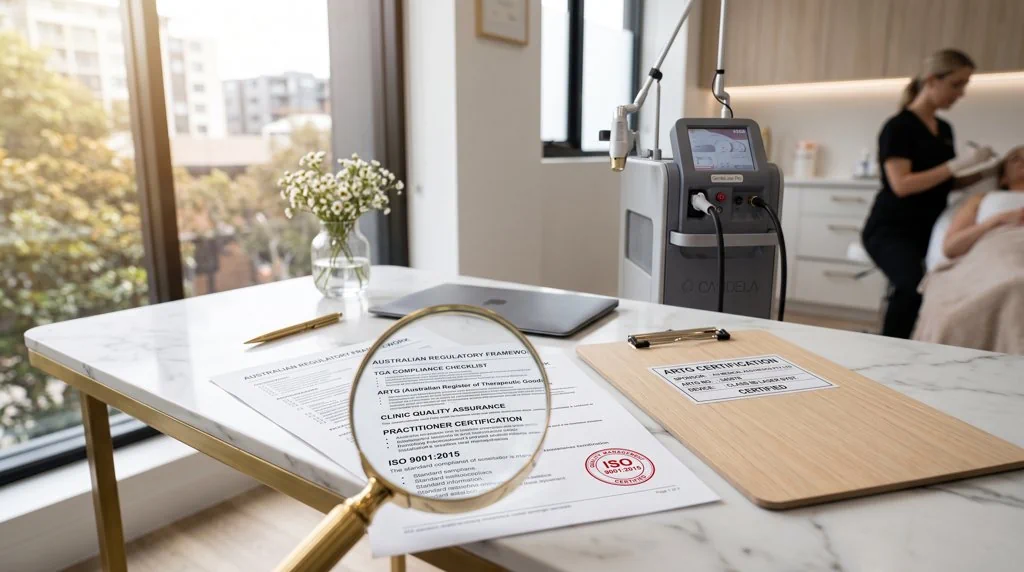
Where a supplier provides an ISO certificate, businesses should also consider verifying:
- the organisation named on the certificate
- the certificate number
- the scope of certification
- the issuing certification body
- validity dates
- whether the certificate actually relates to the manufacturer of the equipment.
A certificate belonging to an unrelated company is not evidence that the equipment itself is appropriately manufactured.
An Australian Supplier and an Australian Sponsor Are Not the Same Thing
Another important distinction is the difference between a supplier and a sponsor.
A retailer may simply sell equipment.
For regulated therapeutic goods, an Australian sponsor has specific responsibilities under therapeutic-goods legislation.
Where a medical device is included in the ARTG, salon owners should establish who the sponsor is rather than assuming the retailer is necessarily the sponsor.
The sponsor information associated with the ARTG entry should correspond to the regulated product being supplied.
What Documentation Should You Request?
The exact documentation required will depend on the device.
For more sophisticated equipment, useful documents may include:
- manufacturer’s name and address
- model number
- serial number
- instructions for use
- intended purpose
- technical specifications
- electrical documentation
- relevant test reports
- risk-management documentation where appropriate
- quality-system documentation
- ISO certification where relevant
- ARTG information where required
- Australian sponsor details
- warranty conditions
- servicing schedule
- maintenance instructions.
Do not judge compliance by the volume of documents supplied.
What matters is whether the documentation is genuine, current and actually applies to the equipment being purchased.

Check That the Model Matches the Documents
This is an easily overlooked issue.
Suppose a supplier sends you an ARTG entry, test report or certificate.
Check that the documentation actually relates to:
- the manufacturer
- product family
- model or device
- intended purpose
being supplied.
A certificate from a manufacturer does not necessarily cover every product that manufacturer produces.
Similarly, an ARTG entry relating to one kind of medical device should not automatically be assumed to cover another.
What About CE Marking?
CE marking can be relevant to medical-device regulatory documentation, but it does not automatically establish Australian compliance.
Australia has its own therapeutic-goods framework.
A device may therefore have valid European regulatory documentation and still need to satisfy separate Australian requirements before lawful supply in Australia.
The same principle applies to other international claims, including US FDA status.
Overseas regulatory evidence can be useful, but it does not replace Australian requirements.
Electrical Safety Matters Too
TGA compliance is not the only consideration when purchasing powered beauty equipment.
Electrical equipment supplied in Australia can also be subject to electrical safety requirements.
Depending on the equipment and jurisdiction, relevant considerations can include:
- electrical safety
- plugs and power supply
- equipment testing
- installation
- servicing
- maintenance.
Imported machines designed for another country’s electrical system should not simply be connected to Australian power because an adaptor physically fits.
Salon owners should obtain appropriate electrical information and professional advice where required.
Laser and IPL Equipment
Laser and IPL equipment requires additional care because regulation can operate at both Commonwealth and state or territory level.
The TGA may regulate a particular device where it meets the definition of a medical device.
Separately, state or territory radiation laws may regulate matters such as:
- possession
- licensing
- operation
- operator qualifications
- particular classes of laser.
Requirements are not uniform across Australia.
A device appearing in the ARTG therefore does not automatically mean:
- the salon may operate it anywhere in Australia
- the therapist may operate it without additional licensing
- the premises automatically satisfy local requirements.
Businesses should check the rules in the jurisdiction where the machine will actually be used.
Training Is Important — But Check What the Certificate Means
Many equipment suppliers provide operator training.
This can be extremely useful and should be considered when purchasing advanced equipment.
However, businesses should distinguish between:
- supplier product training
- professional education
- CPD certification
- nationally recognised training
- licensing required under legislation.
A supplier-issued certificate showing that someone completed machine training is not automatically a government licence or nationally recognised qualification.
The training should be described accurately.
What Good Equipment Training Should Cover
Equipment-specific training should ideally address matters such as:
- operating controls
- treatment parameters
- indications
- contraindications
- client assessment
- safety precautions
- emergency procedures
- recognising adverse reactions
- cleaning and infection control
- maintenance
- troubleshooting
- manufacturer instructions.
Training should relate to the specific technology and equipment being used.
Warranty and Australian Consumer Law
Buying from an Australian business may provide practical advantages if equipment develops a fault.
However, businesses should understand that warranties and statutory rights are not necessarily the same thing.
Depending on the circumstances, Australian Consumer Law can provide protections concerning goods supplied to businesses, including certain consumer guarantees where the statutory criteria are met.
Salon owners should still carefully review:
- warranty duration
- inclusions
- exclusions
- labour costs
- call-out costs
- freight
- replacement terms
- servicing conditions.
A “12-month warranty” tells you very little unless you know what it actually covers.
Servicing and Spare Parts
Before purchasing, ask:
Who repairs this device in Australia?
Also ask:
- Are spare parts stocked locally?
- How long are parts expected to remain available?
- Can a technician attend your location?
- Must the machine be returned to the supplier?
- Who pays freight?
- Is there a loan machine?
- What happens after the warranty expires?
- What is the expected service interval?
These questions can become more important than the original purchase price.
A low-cost device that cannot be repaired locally may become very expensive when it fails.
Calibration and Maintenance
Some equipment requires periodic servicing, testing, calibration or other maintenance.
Salon owners should follow the manufacturer’s requirements and maintain appropriate records.
Useful records can include:
- purchase date
- serial number
- service dates
- technician details
- calibration records where relevant
- repairs
- software updates
- replacement parts
- fault reports.
These records can also be useful if an incident, insurance claim or regulatory issue arises.
Ask Your Insurer Before Purchasing
One of the most valuable checks should happen before purchasing the equipment.
Ask your insurer whether your policy will cover:
- the treatment
- the particular technology
- the practitioner operating it
- the practitioner’s training
- the treatment environment.
Do not assume that because a machine can legally be sold in Australia, your insurance automatically covers treatments performed with it.
Regulatory compliance and insurance requirements are separate issues.
Be Careful With Treatment Claims
The marketing supplied with a machine can create compliance problems.
Claims such as:
- permanently removes fat
- treats medical conditions
- cures pain
- repairs injuries
- guarantees weight loss
- reverses disease
should not simply be copied onto a salon website.
Claims can affect whether a product is considered a therapeutic good and, for regulated medical devices, advertising must remain consistent with the applicable intended purpose.
Australian Consumer Law can also apply to misleading or unsubstantiated claims.
Do Not Assume the Supplier’s Advertising Is Compliant
A supplier providing promotional graphics, brochures or social-media content does not guarantee that every claim in that material is lawful for your business to reproduce.
Salon owners remain responsible for their own advertising.
Before publishing supplied marketing material, check:
- treatment claims
- medical claims
- before-and-after images
- regulatory claims
- ARTG references
- claims of government approval
- guarantees of results.
Risks of Direct Overseas Purchasing
Buying directly from overseas is not automatically illegal or unsafe.
However, it can significantly increase the due diligence required.
Potential issues include:
- unclear manufacturer identity
- uncertain regulatory status
- lack of Australian sponsor arrangements where required
- inadequate technical documentation
- electrical incompatibility
- difficulty obtaining parts
- limited warranty enforcement
- expensive return freight
- no local servicing
- unclear insurance acceptance
- documentation that cannot be independently verified.
Businesses importing regulated medical devices may also take on regulatory responsibilities that ordinary end users do not have.
Direct importing should therefore be approached as a compliance decision, not simply a purchasing decision.
An Australian Supplier Can Still Import the Equipment
It is worth remembering that most equipment sold by Australian distributors is itself manufactured overseas.
The important distinction is not necessarily where the machine was manufactured.
The more useful questions are:
- Who manufactured it?
- Who supplied it in Australia?
- Who is responsible for regulatory compliance?
- What documentation exists?
- Who supports the equipment?
- Who honours the warranty?
- Who can repair it?
A well-established Australian supplier can make these responsibilities considerably easier to identify.
Red Flags When Buying Beauty Equipment
Be cautious where a seller:
- cannot identify the manufacturer
- refuses to provide documentation
- uses “TGA approved” without supporting regulatory information
- displays government logos as product endorsements
- cannot provide an ARTG entry for a medical device that requires one
- sends certificates belonging to another manufacturer
- cannot identify an Australian sponsor where one is required
- guarantees unrealistic treatment outcomes
- has no Australian service arrangements
- provides no meaningful warranty terms
- provides certificates with altered or inconsistent details
- cannot explain the intended purpose of the equipment
- relies only on CE or FDA claims to establish Australian compliance.
None of these factors alone necessarily proves that a product is unlawful, but they justify further investigation before purchase.
A Beauty Equipment Purchasing Checklist
Before committing to a major equipment purchase, check:
- Who is the manufacturer?
- Who is the Australian supplier?
- What is the manufacturer’s intended purpose?
- Is the device a therapeutic good or medical device?
- If ARTG inclusion is required, can you verify the actual ARTG entry?
- Who is the Australian sponsor where applicable?
- Does the regulatory documentation relate to the actual device being supplied?
- What ISO or quality-management documentation is relevant?
- Can supplied certificates be independently verified?
- Does the equipment meet applicable electrical requirements?
- Are additional state or territory requirements relevant?
- Does your insurer cover the treatment and equipment?
- What training is provided?
- What does that training certificate actually represent?
- Where will the equipment be serviced?
- Are replacement parts available?
- What does the warranty actually cover?
- Are treatment and advertising claims substantiated and compliant?
- Are instructions for use and safety documentation supplied?
- What happens if the supplier stops trading?
Price Should Not Be the Only Consideration
A machine costing several thousand dollars less can initially look attractive.
But equipment value should be assessed over its working life.
Consider:
Purchase price + training + servicing + consumables + downtime + repairs + replacement parts + warranty support + regulatory risk.
A slightly more expensive device with good documentation, reliable servicing and local support can ultimately cost considerably less than equipment that cannot be repaired when something goes wrong.
Buying Australian Can Have Real Advantages
There are genuine reasons to favour reputable Australian suppliers.
These can include:
- easier verification
- local technical support
- Australian warranty arrangements
- access to replacement parts
- local training
- easier communication
- consumer-law protections where applicable
- familiarity with Australian requirements.
But the advantage comes from dealing with a reputable and transparent supplier, not merely because the seller has an Australian address.
The Key Principle
The safest purchasing question is not:
“Is this machine ISO certified and TGA approved?”
A better set of questions is:
“What is this device intended to do?”
“What Australian regulatory requirements apply?”
“What evidence supports its compliance?”
“Who is responsible for supplying and supporting it in Australia?”
“Can I safely, legally and insurably offer the treatment?”
That approach provides salon owners with a much stronger basis for making equipment decisions.
Important Disclaimer
This article provides general educational information for Australian beauty and aesthetic businesses and does not constitute legal, regulatory, technical or insurance advice.
Requirements vary depending on the equipment, intended purpose, treatment and Australian state or territory.
Businesses should verify the regulatory status of specific equipment with the relevant manufacturer, Australian sponsor, Therapeutic Goods Administration and state or territory regulator where applicable, and confirm insurance requirements before introducing a new treatment.

Beauty Device Document Verification
Imported Beauty Devices: Document Verification & Consultancy Referral Are you looking to import beauty devices into Australia and need TGA (Therapeutic Goods Administration) approval? We offer a comprehensive document verification service to ensure your products meet Australian standards. Our service includes: Document Review: We verify ISO certifications, safety test reports, and other compliance documents from ….