
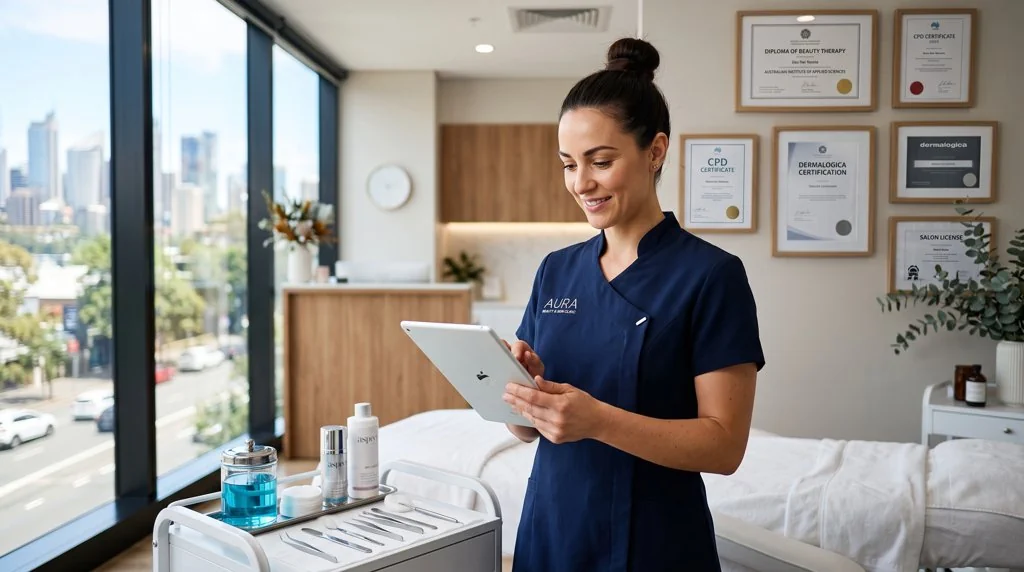
Do You Need a Licence to Work as a Beauty Therapist in Australia?
One of the most common questions asked by people entering the Australian beauty industry is:
Do I need a licence to work as a beauty therapist?
The answer is not a simple yes or no.
Licensing Requirements for Beauty Professionals in Australia: What You Actually Need
One of the most common questions asked by people entering the Australian beauty industry is:
“Do I need a licence to work as a beauty therapist?”
The short answer is:
There is no single national beauty therapist or cosmetology licence that every beauty professional must hold in Australia.
However, that does not mean the industry is unregulated.
Different requirements can apply depending on:
- the treatments you perform
- whether the skin is penetrated
- the equipment you use
- your state or territory
- your local council
- whether prescription medicines are involved
- whether you operate your own business
- whether you employ staff.
Some treatments require specific licences, registrations, qualifications or practitioner authority. Others do not.
The key is to identify the requirements applying to the actual services you provide, rather than searching for one general “beauty licence.”
Is Beauty Therapy a Licensed Profession in Australia?
Beauty therapy itself is not nationally licensed in the same way as professions such as medicine, nursing or dentistry.
Beauty therapists are also not registered through Ahpra simply by virtue of working as beauty therapists.
This means there is no Australian government-issued licence called a:
- beauty therapist licence
- cosmetology licence
- beautician licence
that every practitioner must obtain before performing ordinary beauty services.
However, specific activities performed within the beauty industry can be regulated.
Qualifications and Licences Are Not the Same Thing
This distinction is important.
A qualification demonstrates that someone has completed an education and assessment program.
A licence is a legal authorisation issued under legislation.
They are not interchangeable.
For example, a therapist may hold a nationally recognised Diploma of Beauty Therapy but still need a separate radiation licence to perform a particular laser procedure in a jurisdiction where one is required.
Conversely, a person may provide some beauty services without legislation requiring them to hold a full Diploma of Beauty Therapy.
The correct questions are:
What training is appropriate?
and separately:
What does the law require for this treatment?

Nationally Recognised Beauty Qualifications
Australia has nationally recognised vocational education qualifications for the beauty industry.
Current examples include:
Certificate III in Beauty Services — SHB30121
This qualification covers a range of beauty services and can include areas such as:
- lash and brow services
- waxing
- makeup
- tanning
- selected nail and beauty services.
Certificate IV in Beauty Therapy — SHB40121
This qualification reflects the role of beauty therapists providing a broader range of treatments, including:
- lash and brow services
- waxing
- facial treatments
- massage
- other beauty therapy services depending on electives.
Diploma of Beauty Therapy — SHB50121
The Diploma provides broader and more advanced beauty-therapy training and includes several possible specialisations.
These qualifications are delivered by Registered Training Organisations and are nationally recognised within Australia’s vocational education and training system.
However, they are not national beauty therapy licences.
Do You Legally Need One of These Qualifications?
Not necessarily for every beauty service.
There is no Australia-wide rule saying that every person offering waxing, brows, makeup, facials or similar services must hold a Certificate III, Certificate IV or Diploma.
However, formal qualifications can be:
- required for particular regulated activities
- required by an employer
- required by an insurer
- expected within a professional workplace
- useful evidence of competency.
Businesses should therefore check both legal requirements and insurance requirements before deciding what training is appropriate.
Course Accreditation Does Not Create Legal Authority
A course can be professionally accredited or provide CPD recognition without being a statutory licence.
Likewise, completing an advanced beauty course does not override legislation.
If a law restricts a particular procedure to:
- licensed operators
- registered health practitioners
- authorised prescribers
- people with specified competencies
then completing a private training course does not remove that restriction.
Training, accreditation, licensing and professional registration are separate concepts.
State and Territory Regulation
Most beauty-industry regulation occurs through a combination of Commonwealth, state or territory and local requirements.
These can involve:
- public health
- infection control
- skin penetration
- radiation
- medicines and poisons
- workplace safety
- local premises requirements.
The rules are not identical throughout Australia.
This means advice that is correct in Queensland may not be correct in New South Wales, Victoria or another jurisdiction.
Queensland Personal Appearance Services
Queensland provides a useful example of why precise terminology matters.
Personal appearance services are regulated under Queensland public health legislation.
However, Queensland distinguishes between:
higher-risk personal appearance services
and
non-higher-risk personal appearance services.
Higher-Risk Personal Appearance Services
A higher-risk service generally involves specified skin-penetration procedures where the release of blood or another body fluid is expected.
Examples include certain forms of:
- body piercing
- tattooing
- cosmetic tattooing
- scarification
- skin implantation.
Businesses providing higher-risk personal appearance services require the applicable local government licence.
Operators providing those services also require the designated infection-control competency specified under the Queensland framework.
Non-Higher-Risk Beauty Services
Ordinary beauty therapy services do not automatically fall into the higher-risk licensing category.
Examples of non-higher-risk personal appearance services can include many ordinary beauty treatments such as:
- brow treatments
- facials
- waxing
- beauty therapy services.
Some procedures may still involve skin penetration or infection-control considerations without becoming a Queensland “higher-risk personal appearance service” for licensing purposes.
This distinction is why businesses should check the official Queensland categorisation rather than assume that every treatment involving the skin requires the same licence.
Infection-Control Training in Queensland
Queensland requires a designated infection-control competency for operators providing higher-risk personal appearance services.
The current competency specified by Queensland Health is:
HLTINF005 — Maintain infection prevention for skin penetration treatments.
That requirement should not be presented as a universal Australian qualification required for every beauty therapist.
It applies in the circumstances defined by the relevant Queensland legislation.
New South Wales Skin Penetration
New South Wales regulates businesses performing skin-penetration procedures under public health legislation.
Businesses carrying out regulated skin-penetration procedures must comply with infection-control requirements and generally register with their local council.
NSW Health identifies requirements relating to matters such as:
- premises
- sterile equipment
- sharps
- infection control
- PPE.
The key point is that the requirement relates to the activity being performed.
It should not be simplified into:
“Every beauty salon in NSW needs a skin-penetration licence.”
Check the services offered and the current NSW Health and local council requirements.
Victoria
Victoria also regulates particular personal care and body art activities through public health legislation and local government.
Depending on the activity, requirements can involve:
- premises registration
- infection-control practices
- local council oversight.
Businesses should check the requirements applying to their own municipality and services rather than relying on a national summary.
Other States and Territories
Western Australia, South Australia, Tasmania, the ACT and Northern Territory each have their own public health and business requirements.
These frameworks should not simply be described as “similar council licensing.”
Some jurisdictions rely more heavily on:
- public health legislation
- local government
- registration
- codes or guidelines
- treatment-specific requirements.
Always check the relevant authority for your own state or territory.
Laser Licensing
Laser is one area where beauty professionals can genuinely encounter statutory licensing.
But the rules are not uniform nationally.
For example, Queensland requires an individual use licence to operate specified Class 4 laser apparatus for cosmetic procedures.
Cosmetic laser licences can cover procedures such as:
- hair removal
- skin rejuvenation
- tattoo removal
- superficial vascular lesion treatment
- superficial pigmented lesion treatment.
Applicants need appropriate radiation safety knowledge and practical competency.
Additional conditions can also apply depending on the procedure.
Other Australian jurisdictions have different radiation-control frameworks.
Therefore, do not describe laser licensing as either:
“required everywhere”
or
“not required in Australia.”
Both statements would be inaccurate.
IPL Is Not Automatically Regulated the Same Way as Laser
Laser and intense pulsed light are often grouped together in industry language.
Legally, however, they may not always be regulated in exactly the same way.
Requirements depend on:
- jurisdiction
- equipment
- radiation legislation
- treatment purpose.
Businesses should check the rules applying to the actual equipment they intend to operate.
Cosmetic Tattooing
Cosmetic tattooing is more heavily regulated than many ordinary beauty services because it involves deliberate skin penetration and implantation of pigment.
Depending on the jurisdiction, requirements can include:
- premises registration or licensing
- infection-control competency
- operator requirements
- local government approvals
- hygiene standards.
In some jurisdictions, tattoo-industry legislation can also apply.
Before offering cosmetic tattooing, check the specific requirements in your location.
Microneedling
Microneedling is another treatment where broad Australia-wide claims should be avoided.
It involves skin penetration and therefore raises infection-control and public-health considerations.
However, the precise legal requirements can differ between jurisdictions.
For example, Queensland’s categorisation of personal appearance services does not mean every form of microneedling automatically falls into the same higher-risk business licensing category as tattooing.
Businesses should check:
- treatment depth and method
- jurisdiction
- public health requirements
- premises requirements
- insurance
- training.
Waxing
Waxing is a good example of why the old concept of “all skin penetration requires a licence” is too broad.
Waxing is an ordinary beauty service in many jurisdictions.
It still requires good infection-control practice because minor skin disruption can occur, but this does not automatically make it a licensed higher-risk procedure.
Therapists should follow appropriate hygiene procedures and check local requirements.
Microdermabrasion
Microdermabrasion similarly requires competent practice and infection-control procedures.
However, it should not automatically be described as requiring a higher-risk personal appearance service licence.
Requirements depend on the jurisdiction and treatment circumstances.
Cosmetic Injectables
Cosmetic injectables sit in a different regulatory category from ordinary beauty treatments.
Some injectables involve prescription-only medicines.
Authority to prescribe and administer these medicines depends on:
- professional registration
- prescribing authority
- medicines and poisons legislation
- scope of practice.
A Diploma of Beauty Therapy does not authorise a beauty therapist to prescribe or administer prescription cosmetic medicines.
Likewise, completing a cosmetic injectable course does not by itself create legal authority.
Medical Practitioners, Nurses and Other Registered Professionals
Where cosmetic services involve registered health practitioners, the practitioner must comply with:
- Ahpra requirements
- relevant National Board standards
- professional scope of practice
- applicable medicines legislation
- current cosmetic-procedure guidelines.
Simply being Ahpra registered does not automatically authorise a practitioner to perform every cosmetic procedure.
Beauty Equipment and Licensing
Professional equipment can create additional compliance requirements.
However, the fact that a machine uses advanced technology does not automatically mean the therapist needs a special operator licence.
The relevant questions include:
- what the equipment is
- its intended purpose
- whether it is a regulated medical device
- whether radiation legislation applies
- whether state licensing applies
- whether the insurer imposes competency requirements.
Each device should be assessed individually.
TGA Regulation Is Not an Operator Licence
Another important distinction is between:
equipment regulation
and
operator licensing.
A device being included in the Australian Register of Therapeutic Goods does not automatically authorise a therapist to use it.
Likewise, having an operator licence does not necessarily establish that the device itself satisfies all Australian therapeutic-goods requirements.
These are separate compliance questions.
Do You Need an ABN?
An Australian Business Number is not a beauty therapy licence.
Whether you need an ABN depends on whether you are carrying on an enterprise and your business circumstances.
People operating their own salon, mobile service or independent beauty business commonly require an ABN.
Employees generally operate differently from independent businesses.
Check current Australian Taxation Office and Australian Business Register guidance when setting up your business.
Salon Premises
If you operate your own premises, additional requirements can apply.
Depending on your location and services, these may include:
- planning approval
- zoning
- building requirements
- local council registration
- health inspections
- handwashing facilities
- waste disposal
- skin-penetration premises requirements.
Do not sign a long commercial lease before checking that the proposed premises can legally accommodate your intended services.
Home-Based Beauty Businesses
Home salons can also be subject to local requirements.
Depending on the council, these can involve:
- home-business approval
- parking
- client numbers
- signage
- planning
- structural changes
- health requirements.
Operating from home does not automatically exempt a business from the rules applying to its treatments.
Mobile Beauty Businesses
Mobile therapists should check whether the treatments they provide can lawfully be performed in a mobile environment.
Some higher-risk services may have specific mobile-premises requirements.
The same standards of:
- hygiene
- equipment handling
- waste management
- sharps management
- client privacy
should be maintained outside a conventional salon.
Insurance Requirements
Insurance is not the same as licensing, but it can significantly influence what treatments you can practically offer.
An insurer may require evidence of:
- formal qualifications
- treatment-specific training
- supervised practice
- equipment training
- infection-control education.
Before investing in training or equipment, ask your insurer whether the proposed treatment will be covered.
First Aid
First-aid training is good professional risk management and may be required in some workplace circumstances.
However, ABA should not claim that every self-employed beauty therapist must personally maintain a specific first-aid certificate unless legislation or another applicable requirement genuinely says so.
Businesses should instead ensure they meet applicable workplace first-aid requirements.
Overseas Beauty Qualifications
Someone with an overseas beauty qualification or cosmetology licence should not assume that their overseas licence automatically becomes an Australian licence.
However, because Australia does not have one universal beauty therapist licence, it is also misleading to say every overseas-trained practitioner must have their qualification formally “converted” before doing any beauty work.
The relevant questions are:
- What treatments will the person perform?
- Are statutory qualifications required?
- What does the employer require?
- What does the insurer require?
- Is nationally recognised training necessary for a particular purpose?
Recognition of Prior Learning
Recognition of Prior Learning, or RPL, is a process used within Australia’s vocational education system.
An Australian RTO may assess an individual’s existing knowledge and experience against the requirements of a nationally recognised qualification or unit of competency.
RPL can be useful for experienced practitioners.
However, it is not a generic government process for converting every overseas beauty licence into Australian legal authority.
VETASSESS
VETASSESS performs skills assessments for various purposes, particularly migration and certain occupational assessments.
Beauty professionals should not be told they universally need VETASSESS simply because their qualification was obtained overseas.
Whether a skills assessment is required depends on the purpose for which the assessment is being sought.
A Better Way to Determine What You Need
For each service you plan to offer, work through these questions.
1. What exactly is the treatment?
Identify:
- technique
- products
- equipment
- treatment depth or intensity.
2. Is a specific licence legally required?
Check your state or territory regulator.
3. Is premises registration required?
Check state health requirements and your local council.
4. Is a particular qualification or competency legally required?
Separate statutory requirements from industry recommendations.
5. What training do I need to perform the treatment competently?
This may exceed the minimum legal requirement.
6. Does my insurer have additional training requirements?
Confirm before commencing treatment.
7. Does special equipment regulation apply?
Consider:
- radiation
- medical devices
- electrical safety.
8. Are medicines involved?
If prescription medicines are involved, professional and medicines legislation becomes relevant.
Quick Guide
Ordinary beauty services
Examples:
- brows
- makeup
- waxing
- basic facials
- many nail services.
National beauty licence: Generally no.
Training: Appropriate competency strongly recommended and may be required by employers or insurers.
Other requirements: Hygiene, workplace safety, consumer law and local requirements may apply.
Skin-penetration services
Examples can include:
- cosmetic tattooing
- microneedling
- certain invasive procedures.
National beauty licence: No universal national licence.
Other requirements: State or territory public-health rules, local registration and infection-control requirements may apply.
Laser
National licence: No single national cosmetic laser licence.
Other requirements: Jurisdiction-specific radiation rules can impose operator licensing and other requirements.
Cosmetic injectables
Beauty qualification sufficient: No.
Other requirements: Practitioner registration, prescribing authority, medicines legislation and scope-of-practice requirements apply.
Common Licensing Myths
“Every beauty therapist must have a Diploma.”
Not as a universal Australian legal rule.
A Diploma can be valuable professional training but is not a national licence to practise beauty therapy.
“A Certificate III is the minimum legal qualification for beauty work.”
Not universally.
Requirements depend on the service and jurisdiction.
“Every skin-penetration service needs the same council licence.”
No.
State and local frameworks distinguish between activities in different ways.
“Every Queensland beauty salon needs a Personal Appearance Services licence.”
No.
Queensland distinguishes higher-risk and non-higher-risk services.
“Waxing requires a higher-risk Queensland licence.”
Not simply because waxing can occasionally disrupt the skin.
“A beauty qualification lets me perform injectables.”
No.
Prescription cosmetic medicines operate under healthcare and medicines regulation.
“Laser licensing is the same across Australia.”
No.
Radiation regulation differs between jurisdictions.
“My training certificate is my licence.”
Only if legislation specifically recognises it as part of a licensing pathway.
Most course completion certificates are evidence of training, not statutory licences.
Where to Check
Use official sources appropriate to your location and treatment.
These can include:
- state or territory health department
- local council
- state or territory radiation regulator
- Ahpra and relevant National Board
- Therapeutic Goods Administration
- workplace safety regulator
- Australian Business Register
- professional indemnity and public liability insurer.
Avoid relying solely on social media posts, equipment suppliers or training-provider claims when determining whether a statutory licence is required.
Final Takeaway
There is no universal Australian beauty therapist licence.
Instead, beauty professionals operate within a treatment-specific and jurisdiction-specific regulatory framework.
The safest approach is not:
“Which beauty licence should I get?”
It is:
“For each treatment I intend to offer, what legal authority, training, premises requirements, equipment requirements and insurance do I actually need?”
This distinction prevents both kinds of compliance error:
- assuming a licence is required when it is not
- assuming no regulation applies simply because there is no general beauty licence.
Professional training remains extremely important, but training should always be accurately distinguished from licensing, registration and statutory authority.
Important Disclaimer
This article provides general educational information for Australian beauty professionals and businesses.
It does not constitute legal, regulatory, training or insurance advice.
Requirements vary according to service, equipment, business model, practitioner and Australian jurisdiction. Always verify current requirements with the relevant government authority, local council and insurer before introducing a treatment.

