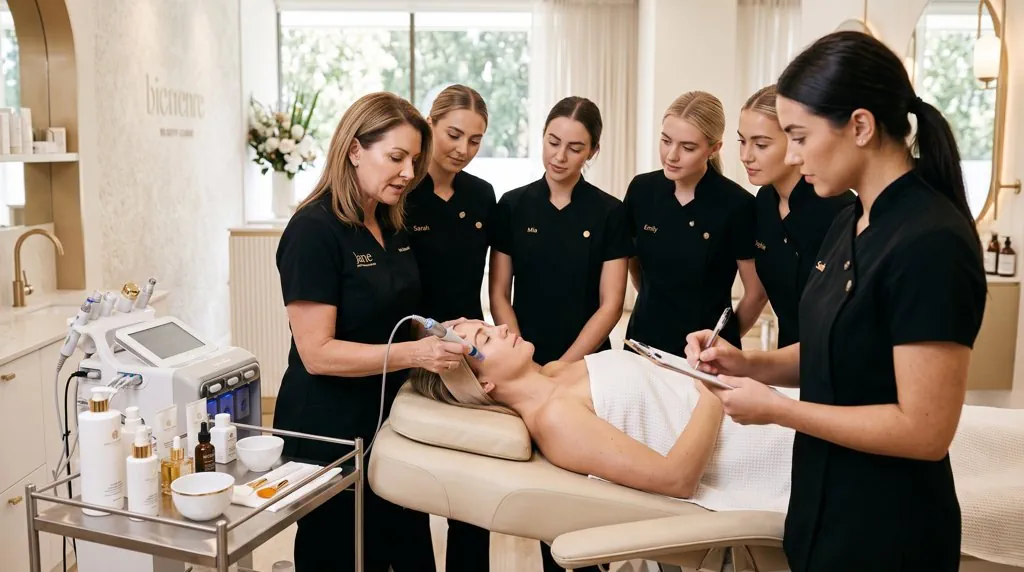
Effective Staff Training Programs for Beauty Salons
Hiring a qualified beauty therapist does not mean the training is finished.
In many ways, it is just beginning.
A new team member may have a qualification.
They may have experience.
They may know how to perform treatments.
But do they know:
How your salon consults?
How your team documents treatment notes?
How you handle contraindications?
How you explain treatment plans?
How you use your equipment?
How you rebook?
How you manage complaints?
How you retail without sounding pushy?
How your salon handles safety, hygiene and privacy?
A qualification proves a person has completed training to a particular standard.
It does not automatically mean they know how to work safely, consistently and commercially inside your particular business.
That is where a proper staff training program comes in.
Training Is Not a One-Off Event
One of the biggest mistakes beauty businesses make is treating training as something that happens:
On the first day.
When a supplier visits.
When a new machine arrives.
Or when something goes wrong.
Effective training is ongoing.
It should evolve with:
- New treatments
- New equipment
- New products
- New staff
- Changing client expectations
- Updated procedures
- Changes in regulation
- Changes in technology
- New business goals
A salon that trains once and assumes everyone will remain competent forever is relying on luck.
Start With the Role, Not the Training Calendar
Before deciding what training your team needs, define what each role actually requires.
For example, a senior skin therapist may need competency in:
Consultation
Treatment planning
Advanced skin treatments
Device operation
Client screening
Aftercare
Retail recommendations
Treatment documentation
Incident response
A receptionist may need:
Booking software
Client communication
Payments
Rebooking
Complaint handling
Privacy
Treatment knowledge
Retail support
Emergency procedures
Training should match the actual role.
Don’t train randomly because a supplier offered a free webinar.
Build a Training Matrix
One of the easiest ways to organise training is to create a skills matrix.
List your team members across the top.
List required skills down the side.
Then record whether each person is:
Not trained
In training
Competent
Needs refresher
Trainer-level
For example:
| Skill | Therapist A | Therapist B | Therapist C |
|---|---|---|---|
| Consultation | Competent | Competent | Needs refresher |
| LED | Competent | Not trained | Competent |
| Skin needling | Trainer-level | In training | Not trained |
| Retail consultation | Needs refresher | Competent | Competent |
| Emergency procedure | Competent | Competent | Competent |
This immediately shows where your business has gaps.
It also reduces the risk of accidentally rostering someone for a treatment they are not ready to perform.
Separate Qualification From Competency
This distinction matters.
Someone may hold a qualification relating to a treatment or modality.
That does not automatically mean they are competent to perform every version of that treatment in your workplace.
Competency may depend on:
The equipment being used
The treatment protocol
The client’s presentation
The product system
The manufacturer’s instructions
The therapist’s recent experience
The salon’s own procedures
A good training program doesn’t simply ask:
“Do you have the certificate?”
It asks:
“Can you demonstrate that you can perform this safely and correctly in our business?”
Create a Proper Onboarding Program
The first week should involve more than:
“Here’s the booking system. That’s the staff room. Good luck.”
A structured onboarding program should introduce:
The business
The role
The team
Salon policies
Client service standards
Consultation procedures
Treatment protocols
Booking systems
Safety procedures
Cleaning procedures
Equipment
Products
Privacy expectations
Complaint handling
Emergency procedures
Performance expectations
Who to ask for help
A strong onboarding process helps new employees become productive faster while reducing confusion and inconsistency.

Don’t Overload New Employees on Day One
Another common mistake is trying to teach everything immediately.
New staff are introduced to:
Twenty products.
Seven treatments.
Four machines.
The booking system.
Retail targets.
Policies.
Closing procedures.
The group chat.
Then expected to remember everything.
Training works better when information is staged.
For example:
Week One
Business orientation, policies, basic systems, client journey and safety.
Week Two
Core treatments and consultation.
Week Three
Retail and rebooking.
Week Four
Additional treatments, equipment and development areas.
The exact structure will vary, but the principle is simple:
Teach in manageable stages.
Use a Train → Demonstrate → Observe → Sign-Off Process
For practical skills, don’t rely on:
“I showed her once.”
A much stronger process is:
1. Train
Explain the treatment, procedure or system.
2. Demonstrate
Show how it should be performed.
3. Observe
Watch the employee perform it.
4. Correct
Provide feedback and coaching.
5. Reassess
Observe again if necessary.
6. Sign Off
Record that the employee has demonstrated the required competency.
This creates much stronger consistency than informal shadowing.
Document Competency
If someone is trained to use a device, perform a procedure or follow a safety process, record it.
Useful training records may include:
Employee name
Training topic
Date
Trainer
Equipment or treatment
Practical assessment
Competency outcome
Refresher date
Relevant certificate
Employee acknowledgement
Good documentation helps managers know who can safely perform what.
It can also become important if an incident, complaint or insurance issue occurs.
Equipment Training Needs to Be Device-Specific
This is particularly important in modern beauty clinics.
Knowing how to use one device does not necessarily mean someone can safely operate another device.
Even where two machines deliver similar treatment categories, there may be differences in:
Settings
Energy delivery
Consumables
Contraindications
Treatment parameters
Maintenance
Cleaning
Safety systems
Manufacturer instructions
Never assume:
“She has used one before, so she’ll figure it out.”
Equipment training should match the actual device being used.
For more information about equipment safety, read:
ABA — Standards for Beauty Equipment in Australia
Supplier Training Is Helpful — But It Isn’t Your Entire Training System
Suppliers can be valuable sources of product and equipment education.
They may provide:
Product knowledge
Treatment protocols
Demonstrations
Device instruction
Marketing support
But supplier education shouldn’t replace your own workplace systems.
Your business still needs to establish:
Who is authorised to perform the treatment
How competency is assessed
How incidents are handled
How records are kept
How staff are supervised
How refresher training occurs
A supplier can train your team on a machine.
They don’t run your salon for you.

Consultation Training Is Just as Important as Treatment Training
A therapist can be technically brilliant and still create poor client outcomes if their consultations are weak.
Train staff to ask:
What concerns brought the client in?
What are they currently using?
What treatments have they had?
What are they expecting?
Are there relevant contraindications or precautions?
What outcome is realistic?
What aftercare is required?
What should prompt referral?
Consultation protects the client and the business.
It also builds trust.
Teach Staff How to Say “No”
This is an underrated training skill.
Employees need confidence to say:
“I don’t think this treatment is appropriate today.”
“I need to check this before proceeding.”
“I’m not qualified to advise on that.”
“I think you should seek medical advice first.”
A therapist who feels pressured to say yes to every client can make unsafe decisions.
Your culture should reward appropriate caution.
Training Should Include Scope of Practice
Beauty therapists need to understand not only what they know, but where their role stops.
That may include:
When to refer
When not to diagnose
When a treatment should not proceed
When medical advice is appropriate
When a concern should be escalated to a manager
Clear scope protects both staff and clients.
Don’t Ignore Infection Control Training
Staff should understand the infection-control procedures relevant to the services they provide.
Training may include:
Hand hygiene
Cleaning
Disinfection
Reprocessing reusable equipment
Sharps management
Waste disposal
Laundry
Personal protective equipment
Cross-contamination prevention
What to do after an exposure incident
Requirements can differ between jurisdictions and services, so use the health authority relevant to your state or territory.
For Queensland businesses, current resources are available here:
Queensland Health — Personal Appearance Services
Safety Training Should Be Practical
Don’t make safety training a folder nobody reads.
Staff should know what to do when:
Someone slips
A device malfunctions
A chemical spills
A client becomes unwell
There is a fire
An employee is injured
A sharps incident occurs
A client becomes aggressive
An electrical hazard is identified
Something goes wrong during treatment
Train for real situations.
For a broader guide, read:
ABA — Workplace Safety in Beauty Salons
Include Client-Service Training
Technical skills are only one half of the client experience.
Train staff on:
Greeting clients
Running on time
Explaining delays
Professional communication
Consultation
Managing expectations
Rebooking
Handling price objections
Dealing with complaints
Client privacy
Treatment-room etiquette
A technically perfect treatment can still generate a poor review if the client feels ignored, rushed or uncomfortable.
Teach Complaint Handling Before a Complaint Happens
Employees shouldn’t first learn your complaint process while an angry client is standing at reception.
Train staff to:
Listen
Avoid arguing
Stay calm
Know what they can resolve
Know when to involve a manager
Document relevant details
Avoid admitting liability prematurely
Protect client privacy
For more guidance:
ABA — What to Do When a Client Complains About an Employee
Retail Training Should Not Be “Sell More”
Poor retail training sounds like:
“Everyone needs to hit $500 this week.”
Good retail training teaches staff:
How to identify genuine client needs
How to explain products clearly
How to recommend without pressure
How to connect homecare to treatment outcomes
How to avoid overpromising
How to document recommendations
Clients usually dislike being sold to.
They often appreciate relevant professional advice.
Train for that distinction.
Rebooking Is a Skill Too
Some therapists naturally rebook.
Others avoid it because they think it feels pushy.
Train staff to explain:
Why the next appointment matters
When it should occur
What the treatment plan involves
What the client can expect
Rebooking should feel like treatment planning, not pressure.
Include Business Education
Employees don’t need to become accountants.
But understanding basic salon economics can improve decision-making.
Teach concepts such as:
Treatment duration
Product cost
Room utilisation
Late cancellations
No-shows
Rebooking
Retail
Average client spend
Time management
Why running late affects the entire diary
This helps employees understand how their role contributes to the wider business.
Train Managers Differently
A great therapist does not automatically become a great manager.
Managers may need additional development in:
Delegation
Feedback
Conflict management
Performance conversations
Scheduling
Coaching
Workplace safety
Client complaints
Staff motivation
Documentation
Leadership
Promoting your best therapist into management without training them is unfair to everyone involved.
Include Conflict-Management Training
Salon teams work in close environments.
Tension happens.
Managers should know how to intervene before small disagreements become major workplace problems.
For more guidance:
ABA — Managing Personality Conflicts in the Workplace
Use Different Training Methods
People learn differently.
Don’t rely on one training format.
Use combinations of:
Demonstration
Written procedures
Videos
Role-play
Shadowing
Practical observation
Team workshops
Online learning
Supplier education
One-on-one coaching
Case studies
Quizzes
Competency assessments
The method should suit the subject.
You wouldn’t teach emergency evacuation the same way you teach brow mapping.
Role-Play Is Especially Useful for Client Conversations
Staff can practise:
A client wanting an unsuitable treatment
A price objection
A client complaining
A client arriving late
A difficult consultation
An unrealistic expectation
A refund request
A client asking for medical advice
Role-play can feel awkward.
It also works.
The first time someone practises a difficult conversation should not be when an upset client is standing in front of them.
Build SOPs Around Training
Training becomes much easier when your business has clear Standard Operating Procedures.
An SOP can cover:
Purpose
Who can perform the procedure
Required equipment
Preparation
Client screening
Treatment steps
Safety precautions
Cleaning
Aftercare
Documentation
Escalation
Then staff aren’t expected to remember everything from verbal instruction.
They have a consistent reference.
But Don’t Let SOPs Replace Training
Having a procedure doesn’t mean people have been trained.
A PDF stored in Google Drive is not a competency system.
Employees should:
Understand the procedure.
Demonstrate it.
Ask questions.
Receive feedback.
Be assessed where appropriate.
Documentation supports training.
It doesn’t replace it.

Make Training Part of Paid Work
One of the easiest ways to kill a learning culture is:
“Here’s a three-hour course. Do it at home tonight.”
If training is required by the employer, employment and award obligations may apply to that time.
Check the applicable employment arrangements and current Fair Work requirements.
Fair Work Ombudsman — Hair and Beauty Industry Award
Plan training properly rather than assuming professional development belongs in employees’ personal time.
Protect Breaks and Capacity on Training Days
Don’t schedule:
Full treatment column + two-hour training + team meeting + stocktake
and call it development.
Training requires concentration.
Create space for it.
Otherwise employees will either rush the training or fall behind with clients.
Refresher Training Matters
Skills fade.
People develop shortcuts.
Procedures change.
Equipment gets upgraded.
New risks emerge.
Use refresher training where appropriate.
Good topics for periodic review include:
Emergency procedures
Infection control
Equipment safety
Consultation
Incident response
Privacy
Client complaints
High-risk procedures
Workplace behaviour
Refresher frequency should reflect the subject, risk and business requirements rather than a random annual calendar.
Use Incidents as Training Signals
If something goes wrong, ask:
Was this a one-off mistake?
Was the procedure unclear?
Was training inadequate?
Did several employees misunderstand the same process?
Has the treatment changed?
Does everyone need refresher training?
An incident can reveal a gap in your training system.
Don’t only correct the person involved.
Correct the system where necessary.
Client Complaints Are Training Data
Repeated comments such as:
“Nobody explained the aftercare.”
“I wasn’t told what to expect.”
“The therapist seemed rushed.”
“I received different advice from two staff members.”
are telling you something.
Use complaints and reviews to identify training opportunities.
Don’t Train Only Your Weakest Employees
Training shouldn’t feel like punishment.
If only struggling employees ever receive training, everyone will learn:
Training means you’re in trouble.
Create development opportunities for strong performers too.
Advanced education.
Leadership training.
New treatment skills.
Mentoring.
Professional development.
This helps retain ambitious employees.
Create Career Pathways
Training becomes much more powerful when employees can see where it leads.
For example:
Junior Therapist
↓
Beauty Therapist
↓
Senior Therapist
↓
Advanced Skin Therapist
↓
Team Leader
↓
Clinic Manager
Not every salon needs those exact titles.
The point is progression.
Employees are more likely to value development when they understand how new skills can create new opportunities.
Don’t Train People for Responsibilities You Never Give Them
A common frustration is:
“The salon paid for leadership training, but I’m still not allowed to make any decisions.”
Development needs opportunity.
If someone is being trained for leadership, gradually give them appropriate leadership responsibilities.
Otherwise training becomes theoretical.
Measure Whether Training Worked
Don’t ask only:
“Did everyone attend?”
Ask:
Did behaviour change?
Did treatment consistency improve?
Did complaints decrease?
Did retail confidence improve?
Did rebooking improve?
Did employees make fewer errors?
Can they demonstrate the skill?
Are procedures being followed?
Attendance is not the same as effectiveness.
Create Training KPIs Carefully
Useful training measures might include:
Competencies completed
Treatment quality
Client feedback
Consultation quality
Rebooking
Retail conversion
Procedure compliance
Error reduction
Avoid turning every training initiative into aggressive sales pressure.
The purpose is capability.
Commercial improvement should follow from better capability.
Ask Staff What They Want to Learn
Managers often choose training based entirely on what the business thinks employees lack.
Ask employees too.
Questions might include:
Which treatments do you want more confidence in?
What client conversations do you find difficult?
What would help you perform better?
What skill would you like to develop next?
Where do you want your career to go?
Their answers can reveal gaps you haven’t noticed.
Build a 12-Month Training Plan
Instead of reacting randomly, map development across the year.
For example:
Quarter 1
Consultation, client journey and rebooking.
Quarter 2
Treatment protocols and advanced technical skills.
Quarter 3
Retail, client communication and complaint handling.
Quarter 4
Safety refreshers, business review and development planning.
Then add individual training needs around that structure.
A plan prevents training from disappearing during busy periods.
Create Individual Development Plans
Team training is useful.
But people also need different development.
One therapist may need confidence with consultation.
Another needs advanced technical training.
Another needs leadership development.
Another needs help with time management.
A simple individual development plan can include:
Current strengths
Development areas
Training required
Target date
Support needed
Review date
Career goal
That makes development much more meaningful.
Who Should Be Allowed to Train Others?
Don’t assume your most experienced employee is automatically your best trainer.
Good trainers need to:
Explain clearly
Demonstrate consistently
Give constructive feedback
Follow your procedures
Avoid teaching shortcuts
Assess fairly
Know when someone is not ready
Choose trainers carefully.
Watch for “This Is How I’ve Always Done It”
Experienced employees sometimes resist updated procedures.
They may say:
“I’ve been doing this for 15 years.”
Experience is valuable.
It doesn’t mean systems should never change.
New equipment, updated safety guidance, better evidence, different products and new procedures can require experienced staff to retrain too.
No one should be exempt from critical training simply because they’ve been there longest.
Common Staff Training Mistakes
Training only when something goes wrong
Training should be proactive.
Assuming a qualification equals workplace competency
Assess the person against your actual treatment, equipment and procedures.
No documentation
If training matters, record it.
Supplier education as the entire training system
Supplier training should support—not replace—your own competency management.
Too much information at once
Stage onboarding and development.
No practical assessment
Watching a demonstration isn’t the same as performing the skill.
No refresher training
Competence needs maintenance.
Training only technical treatments
Communication, consultation, safety and management matter too.
No time allocated
Training squeezed between clients rarely works well.
No follow-up
If nobody checks whether the skill improved, the training may achieve nothing.
ABA Expert Tip: Ask “What Must Every Person in This Role Be Able to Demonstrate?”
Don’t start with:
“What courses should we book?”
Start with:
“What does excellent performance in this role actually require?”
Then build training around those competencies.
That one change shifts your training program from random education to workforce development.
A Simple Training Framework for Beauty Businesses
Use:
1. IDENTIFY
What skills and knowledge does each role require?
2. ASSESS
What can each team member currently demonstrate?
3. TRAIN
Provide targeted education and practical instruction.
4. OBSERVE
Watch the skill being performed.
5. SIGN OFF
Document competency where appropriate.
6. REFRESH
Review skills when procedures, treatments, equipment or risks change.
7. DEVELOP
Help employees build new skills and career pathways.
That’s a training system.
Not simply a training day.
Frequently Asked Questions
How often should salon staff be trained?
There is no single frequency appropriate for every topic.
Training should occur during onboarding, when new treatments or equipment are introduced, when procedures change, when gaps are identified and when refresher training is appropriate.
Should qualified beauty therapists still receive workplace training?
Yes.
Qualifications don’t necessarily cover your specific equipment, procedures, products, policies or client-service standards.
Should staff training be documented?
For important technical, safety and competency-based training, maintaining appropriate records is good practice and can be especially important where higher-risk treatments or equipment are involved.
Should salon staff be paid for training?
Where training is required by the employer, applicable employment laws, awards and workplace arrangements should be considered.
Check current Fair Work requirements relevant to your team.
Should every therapist receive the same training?
No.
Core business standards may apply to everyone, but technical and development training should reflect the employee’s role and responsibilities.
Can supplier training prove someone is competent?
Supplier training can be valuable evidence of education, but businesses should still determine whether the employee can safely and consistently perform the procedure using the salon’s actual systems and equipment.
How can I tell whether training worked?
Observe performance.
Look at treatment consistency, client feedback, complaints, safety issues, conversion metrics where relevant and whether employees can demonstrate the required behaviour or skill.
What should I do if someone fails a competency assessment?
Don’t automatically punish them.
Identify the gap, provide further training or supervision and reassess.
If ongoing inability to meet reasonable role requirements becomes a performance issue, manage it through an appropriate performance process.
Useful Australian Resources
Fair Work Ombudsman — Hair and Beauty Industry Award
Safe Work Australia — Managing WHS Risks
Safe Work Australia — Psychosocial Hazards
Queensland Health — Personal Appearance Services
Final Thoughts
The best beauty businesses don’t leave staff development to chance.
They don’t assume:
“She’s qualified, so she knows everything.”
They build systems.
They define what good looks like.
They train.
They observe.
They coach.
They document.
They refresh.
And they give employees somewhere to grow.
That produces more than better therapists.
It produces:
More consistent treatments.
Safer practices.
More confident employees.
Better client experiences.
Stronger retention.
Better leadership.
And a more valuable business.
Training isn’t simply an expense.
Done properly, it is one of the most powerful investments a beauty business can make in both its people and its future.