Beauty Equipment Compliance and Safety Standards in Australia: What Salon Owners Need to Know
Beauty technology continues to evolve rapidly, giving Australian salons and clinics access to an increasingly sophisticated range of professional equipment.
From LED phototherapy and radiofrequency systems to body-contouring equipment, skin treatment devices and other salon technologies, purchasing professional equipment can be a significant investment.
However, there is an important point every salon owner should understand:
There is no single compliance rule that applies to every beauty device in Australia.
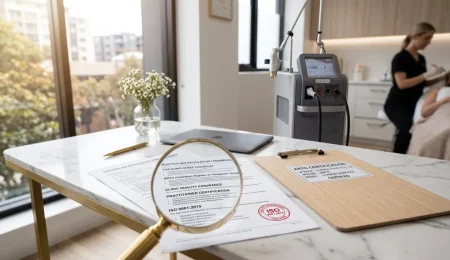
A device is not automatically a medical device simply because it uses advanced technology, and terms such as CE marked, FDA cleared, ISO certified or professional use do not, by themselves, establish that a device complies with Australian requirements.
The regulatory position depends on factors including the device itself, its intended purpose, the claims made about it and how it is supplied and used.
Understanding these distinctions can help salon owners make better purchasing decisions and avoid relying on compliance claims that may be incomplete or misleading.
Does Beauty Equipment Need TGA Approval in Australia?
Not every piece of equipment used in a beauty salon is regulated by the Therapeutic Goods Administration (TGA).
The first question is whether the product falls within Australia’s definition of a medical device or other therapeutic good.
The TGA advises that determining whether a product is a medical device involves considering information such as:
- the manufacturer’s intended purpose;
- instructions for use;
- product labelling;
- advertising and promotional material; and
- technical documentation.
This means two pieces of equipment using similar technology should not automatically be assumed to have exactly the same regulatory status.
One may be marketed purely for cosmetic purposes, while another may make therapeutic or medical claims that affect how it is regulated.
Salon owners should therefore avoid rules such as:
“All LED machines must be TGA registered.”
or:
“All body-contouring machines require TGA approval.”
These statements are too broad.
Instead, the regulatory status of the specific device and its intended purpose should be established.
Understanding the ARTG
The Australian Register of Therapeutic Goods (ARTG) is the public register of therapeutic goods that can generally be lawfully supplied in Australia.
Where a product is a medical device requiring ARTG inclusion, it generally must be included in the ARTG before it can lawfully be supplied in Australia unless a specific exemption or other lawful pathway applies.
The TGA states that each ARTG entry is associated with the relevant sponsor, manufacturer and kind of medical device.
This is important when purchasing equipment.
Finding what appears to be a similar device on the ARTG does not necessarily establish that the particular machine being offered by another supplier is covered by that entry.
Where ARTG inclusion is relevant, ask the supplier for sufficient information to identify the applicable ARTG entry and Australian sponsor.
You can then verify the information rather than relying solely on statements such as:
- “TGA approved”;
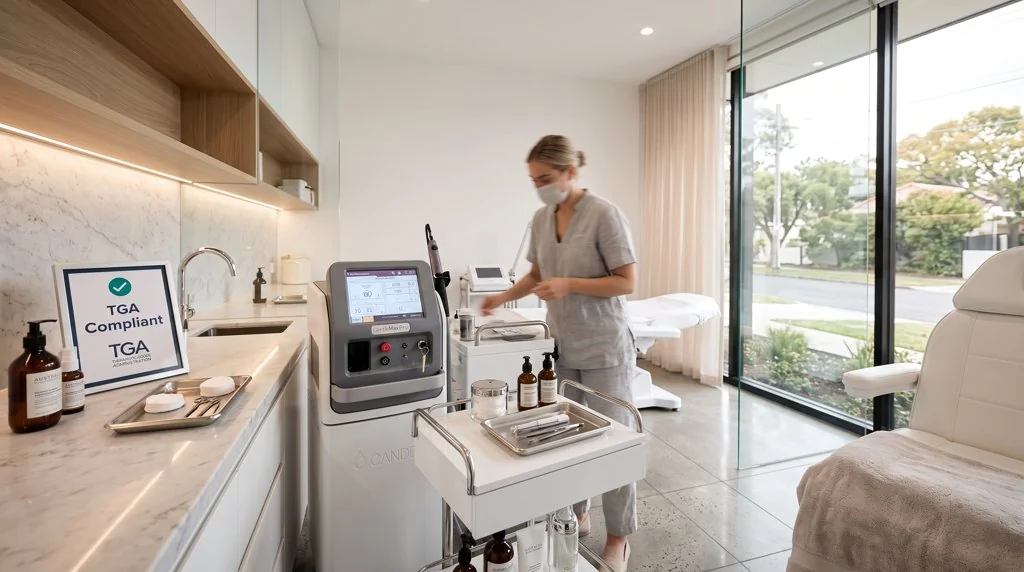
- “TGA compliant”;
- “registered machine”; or
- “Australian approved.”
What Is an Australian Sponsor?
Medical devices supplied in Australia generally require an Australian-based sponsor.
The sponsor has important regulatory responsibilities and acts as the primary contact between the TGA and the manufacturer.
For devices subject to the medical-device framework, sponsor responsibilities can include maintaining access to regulatory and technical information, meeting ongoing regulatory requirements, record keeping, adverse-event reporting and assisting with corrective actions or recalls.
This makes the identity of the Australian sponsor important when evaluating regulated equipment.
Before purchasing a device represented as being included in the ARTG, salon owners can ask:
Who is the Australian sponsor?
What is the ARTG entry?
Does that entry correspond to this manufacturer and kind of device?
A reputable supplier should be able to provide clear information where ARTG inclusion is required.
What About CE Marking?
Australian salon owners frequently encounter equipment advertised as CE certified or CE marked.
CE marking relates to European regulatory requirements for products to which the applicable European legislation applies.
It should not be treated as Australian regulatory approval.
International regulatory documentation may form part of the evidence relevant to a manufacturer’s compliance or conformity assessment, depending on the device and regulatory pathway, but a CE mark alone does not establish that a regulated medical device can legally be supplied in Australia.
If a supplier relies heavily on CE marking while avoiding questions about Australian regulatory requirements, ask for further information.
What Does ISO 13485 Mean?
Another commonly advertised credential is ISO 13485.
ISO 13485 is an internationally recognised quality-management-system standard associated with the design and manufacture of medical devices.
Certification can provide useful information about a manufacturer’s quality-management system.
However, an ISO 13485 certificate should not be interpreted as proof that every individual device manufactured by that company:
- is included in the ARTG;
- has been approved for every advertised purpose;
- complies with every Australian requirement; or
- is appropriate for your particular salon or treatment.
Salon owners should therefore regard ISO certification as one component of supplier and manufacturer due diligence, rather than a substitute for checking the regulatory position of the device itself.
Electrical Safety Matters Too
TGA regulation is only one possible part of beauty-equipment compliance.
Electrical equipment supplied and used in Australia can also be subject to electrical safety, product safety, workplace safety and other requirements.
Before purchasing electrically powered salon equipment, check that the supplier can provide appropriate information about the equipment’s electrical compliance for Australia.
Do not assume that an overseas plug fitted with an adaptor makes imported equipment suitable for professional use in Australia.
Professional equipment should also be installed, operated, inspected, maintained and serviced in accordance with applicable requirements and manufacturer instructions.
Depending on the equipment and workplace, additional electrical inspection or testing obligations may apply.

State and Territory Requirements
Beauty businesses must also remember that Australian requirements are not always uniform nationally.
Some treatments and technologies may be subject to additional state or territory controls.
This is particularly important for technologies such as certain lasers and intense pulsed light (IPL) systems, where licensing, registration, possession, use, training or treatment requirements can differ between jurisdictions.
Do not assume that because a treatment can legally be performed under particular conditions in one state, exactly the same rules apply everywhere in Australia.
Before introducing higher-risk technology, check the requirements of the regulator responsible for your state or territory.
Training and Legal Permission Are Different Things
Training is an essential part of safe professional practice, but completing a course does not automatically create a legal entitlement to perform every treatment or operate every type of equipment.
A training certificate demonstrates completion of the particular education described by that provider.
It does not override:
- legislation;
- licensing requirements;
- scope-of-practice restrictions;
- state or territory requirements;
- workplace requirements;
- manufacturer instructions; or
- insurer conditions.
This distinction is particularly important when purchasing advanced equipment.
Ask both:
Have I received appropriate training?
and:
Am I legally permitted and appropriately insured to provide this treatment in my location and circumstances?
They are separate questions.
Check Your Insurance Before Introducing a New Treatment
Before purchasing expensive equipment or advertising a new service, contact your insurer or insurance broker.
Provide the exact treatment and technology you intend to use rather than simply asking whether “beauty treatments” are covered.
Ask whether:
- the treatment is covered;
- the particular equipment or technology is acceptable;
- minimum qualifications or training apply;
- exclusions apply;
- specific consent or record-keeping requirements apply; and
- your policy needs to be amended before treatments commence.
Where possible, obtain confirmation in writing.
Insurance policies and underwriting criteria vary, so another salon’s insurance arrangements should not be relied upon as evidence that your own business is covered.
Servicing, Maintenance and Repairs
Compliance does not finish when a machine is delivered.
Professional equipment should be maintained throughout its working life.
Before purchasing, establish:
- who services the equipment;
- where servicing is performed;
- whether technicians are available in Australia;
- recommended servicing intervals;
- whether replacement parts are readily available;
- what maintenance records should be retained;
- what happens if the machine develops a fault;
- the length and scope of the warranty; and
- who is responsible for warranty support.
Keep service records, repair reports, maintenance documentation and relevant safety records with the equipment file.
If an incident occurs, good documentation can become extremely important.
Be Careful With Treatment and Marketing Claims
Equipment compliance and advertising compliance are closely connected.
If a device is a therapeutic good, advertising must comply with applicable therapeutic-goods legislation and the Therapeutic Goods Advertising Code.
Claims about a medical device also need to remain consistent with its intended purpose.
Beauty businesses should therefore be cautious about simply copying treatment claims supplied in overseas marketing material.
Claims such as:
- “treats disease”;
- “clinically proven”;
- “medical grade”;
- “permanent”;
- “guaranteed”;
- “TGA approved”; or
- claims about treating particular medical conditions
should never be used simply because they appear in a manufacturer’s brochure or on another salon’s website.
Advertising should be accurate, supportable and appropriate for the regulatory status and intended purpose of the product.
Australian Consumer Law requirements regarding misleading or deceptive representations may also apply.
Importing Equipment Directly From Overseas
Buying directly from an overseas manufacturer can appear attractive, particularly when the purchase price is substantially lower.
However, direct importing can create additional responsibilities and risks.
This is especially important where the equipment is regulated as a medical device.
The TGA specifically warns that purchasing medical devices from overseas through the internet is a form of importing. Depending on the circumstances, importing or supplying a medical device can create regulatory responsibilities.
Before importing equipment yourself, establish:
- whether the product is regulated as a medical device;
- whether ARTG inclusion is required;
- who will hold the relevant Australian regulatory responsibilities;
- whether the equipment meets Australian electrical requirements;
- who will provide servicing and repairs;
- whether spare parts are available;
- whether the warranty is enforceable in Australia;
- whether your insurer will cover the equipment; and
- whether any state or territory restrictions apply.
A lower purchase price can become considerably less attractive if the machine cannot be appropriately used, serviced or insured.

New Medical Device Identification Requirements
Australia is progressively implementing a Unique Device Identification (UDI) system for medical devices.
From 1 July 2026, mandatory UDI requirements began applying to specified higher-risk medical devices, with implementation occurring progressively according to device classification and regulatory arrangements.
Many ordinary salon products will not be affected.
However, the introduction of UDI is another reason salon and clinic owners using regulated medical technology should obtain equipment through transparent supply channels and retain accurate information identifying the device, manufacturer and Australian sponsor.
Beauty Equipment Compliance Checklist
Before purchasing professional beauty equipment, ask the following questions.
Regulatory Status
- What is the manufacturer’s stated intended purpose for the device?
- What treatment claims are made?
- Is the product a therapeutic good or medical device in Australia?
- If ARTG inclusion is required, what is the relevant ARTG entry?
- Who is the Australian sponsor?
Manufacturer and Supplier
- Who manufactures the equipment?
- Who is the Australian supplier?
- Can the supplier provide relevant compliance documentation?
- Can regulatory claims be independently verified?
- Is there Australian warranty support?
Electrical and Technical Safety
- Is the equipment appropriate for supply and professional use in Australia?
- Have relevant electrical requirements been considered?
- Are operating instructions supplied?
- Are safety warnings and contraindications clearly documented?
Training
- Is appropriate operator training available?
- Does training cover contraindications and client selection?
- Does it include safe operating procedures?
- Does it include emergency and adverse-event procedures?
- Have any jurisdiction-specific licensing or training requirements been checked?
Insurance
- Has the treatment been disclosed to the insurer?
- Has the technology or device been disclosed?
- Are minimum training requirements specified?
- Are there exclusions or conditions?
- Has confirmation of cover been obtained where appropriate?
Maintenance
- Is Australian servicing available?
- Are replacement parts available?
- Is there a documented maintenance schedule?
- Are maintenance and servicing records retained?
- Is there a clear procedure for equipment faults?
A Safer Approach to Beauty Equipment Purchasing
Professional beauty equipment can be an excellent investment, but the decision should involve more than comparing treatment features and purchase prices.
A responsible purchasing process considers:
the device + its intended purpose + Australian regulatory requirements + your location + operator training + insurance + maintenance + appropriate advertising.
Most importantly, avoid relying on a single certificate, logo or supplier statement as proof of compliance.
Statements such as “CE marked,” “ISO certified,” “FDA cleared,” “Australian approved” or “TGA compliant” should prompt further questions rather than end your due diligence.
The goal is not to make beauty technology unnecessarily complicated.
It is to ensure that salon owners know what to verify, who to ask and where to obtain authoritative information before making a significant investment or introducing a new treatment.
Where to Check Current Requirements
Regulations, guidance and licensing requirements can change.
For current information, salon owners should consult the relevant official authority rather than relying solely on articles, suppliers or training providers.
Therapeutic Goods Administration (TGA)
For medical-device status, ARTG requirements, Australian sponsors and therapeutic-goods advertising.
Australian Competition and Consumer Commission (ACCC)
For Australian Consumer Law and product-safety information.
Your state or territory regulator
For requirements applying to particular equipment or treatments in your jurisdiction, including any radiation, laser or IPL requirements.
Your insurer or insurance broker
For confirmation that your proposed treatments, equipment and operator training meet the conditions of your individual policy.
Important Disclaimer
This article provides general educational information for Australian beauty businesses. It is not legal, regulatory or insurance advice.
Requirements can vary according to the device, intended purpose, treatment, business activities and Australian state or territory. Regulations and regulatory guidance may also change.
Beauty business owners should verify current requirements with the Therapeutic Goods Administration, relevant state or territory authorities, qualified advisers and their insurer before purchasing or using professional beauty equipment.