Ethical Upskilling: Choosing Beauty Courses That Align With Your Brand and Professional Standards
The beauty industry has never been short of new treatments, technologies and training opportunities. A treatment can appear on social media and, within weeks, it can feel as though every salon is suddenly offering it. Soon the course advertisements follow: become certified in a day, add a high-profit service to your menu, secure your place before enrolments close.
It creates a powerful sense that if you don’t act quickly, your business will fall behind.
That is exactly the point at which beauty professionals should slow the decision down rather than speed it up.
Upskilling can be one of the best investments you make in your career or business. The right education can deepen your knowledge, improve client outcomes, open new career pathways and create valuable new services. The wrong course can leave you with an impressive-looking certificate but little practical confidence, equipment that rarely gets used, a treatment your clients never wanted or, in more serious cases, questions about insurance, scope or whether you should be providing the service at all.
Ethical upskilling is not about collecting certificates. It is about making deliberate decisions about the professional you want to become and the business you want to build.
Start With Your Clients and Your Business — Not Instagram
Before asking, “What course should I do next?”, ask a more useful question: what do my clients need us to become better at?
Perhaps clients are increasingly asking about pigmentation, sensitive skin, ageing concerns, acne, advanced skin treatments, brows, lashes or hair removal. Perhaps the biggest opportunity isn’t a new treatment at all. Your business may benefit more from advanced consultation training, skin science, client communication, retail education, infection control, leadership or better treatment planning.
This distinction matters because beauty businesses can become so focused on expanding their treatment menus that they overlook the value of becoming exceptionally good at what they already do.
A salon with 15 treatments delivered consistently, confidently and profitably may have a stronger proposition than one with 50 treatments that staff perform occasionally. Depth of expertise can be a much stronger competitive advantage than the size of your service menu.
Your training decisions should also reflect your positioning. A clinic built around evidence-informed skin treatments, conservative treatment planning and long-term skin health will make different education decisions from a trend-led beauty studio whose clients actively seek the newest services. Neither approach is automatically right or wrong. What matters is consistency between what your business promises and what it delivers.
Before enrolling, ask whether the new skill solves a genuine client problem, complements your existing services and supports what you want the business to be known for. If the only reason you are considering the course is because competitors are doing it, that is worth recognising before you spend the money.

Understand Exactly What You Are Buying
One of the most confusing areas in beauty education is the language used around qualifications, certificates, accreditation and professional development.
A private education provider may legitimately issue a certificate confirming that you completed its course. That does not automatically mean the course is nationally recognised training.
Australia has a formal Vocational Education and Training (VET) system. Registered Training Organisations (RTOs) can deliver nationally recognised training within their registered scope. Australia’s national register, training.gov.au, allows you to search RTOs and nationally recognised training products.
This does not mean private professional development is somehow inferior. There are excellent private educators offering highly specialised training, and some valuable professional-development subjects may not correspond neatly with nationally recognised training products. The important issue is transparency: you should understand what you are purchasing and what the credential you receive actually represents.
If a provider describes training as nationally recognised, accredited or leading to a formal qualification or unit of competency, ask for the RTO name and number, the relevant course or unit code and the exact credential you will receive. These details can then be checked against the national register.
The same caution applies to the word “certified”. A certificate can confirm successful completion of private professional development, but simply having a certificate does not tell you whether the training was nationally recognised, how competency was assessed or what prerequisites were required.
A useful question before paying for any course is therefore not simply, “Do I receive a certificate?” but “Exactly what does the credential I receive represent?”
A reputable education provider should be able to answer that clearly.
A Course Certificate Is Only One Part of the Picture
Completing training does not automatically answer whether you can safely, legally and insurably introduce a treatment into your business.
Depending on the treatment and where you operate, other considerations may include state or territory requirements, infection-control obligations, radiation or laser licensing, equipment requirements, insurance conditions, professional scope, client screening and workplace procedures.
Beauty regulation is not identical across Australia. This is particularly important for treatments involving certain devices or higher-risk procedures, where requirements can differ between jurisdictions. Before investing heavily in a new modality, check the relevant government regulator rather than relying solely on statements made by an educator, supplier or another salon.
Insurance should also be investigated before you enrol or purchase equipment.
Contact your insurer and explain exactly what treatment you intend to offer. Ask whether it will be covered and whether your insurer has requirements concerning prerequisite qualifications, the training provider, practical hours, equipment, supervision or certification. Some insurers may impose specific conditions or exclusions, and it is far better to discover these before investing thousands of dollars.
Our guide to Professional Indemnity Insurance for Beauty Therapists and Salons explains why beauty businesses should regularly review whether their actual treatments and equipment match the activities their insurer understands them to perform.
Another important question is whether the course has appropriate prerequisites. A short introductory course may be perfectly reasonable for one service but completely inadequate preparation for another. If potentially complex or higher-risk training is promoted as suitable for absolutely anyone with no prior knowledge, it is reasonable to ask how students will develop the underlying knowledge required to make safe treatment decisions.
Look Beyond the Course Duration
A one-day course is not automatically a poor course, just as a longer course is not automatically a good one. The real question is whether the amount and type of education are appropriate for the complexity of the skill being taught.
This is where beauty professionals need to look beyond the headline number of training hours.
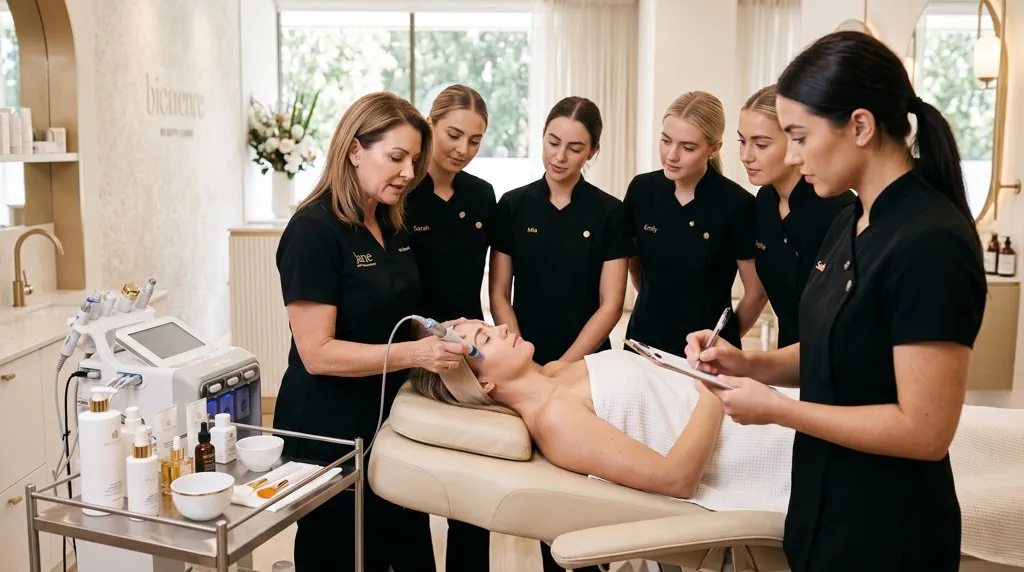
An eight-hour course might include theory, demonstrations, product information, breaks and group observation, leaving relatively little time for each student to perform the treatment. Before enrolling in practical training, ask how many students will attend, how many models will be available, how much supervised practical experience each student receives and how competency is assessed.
There is a significant difference between watching somebody perform a treatment, performing it once under supervision and being able to perform it competently across different client presentations.
Quality training should also cover what happens when everything does not go perfectly. Before-and-after photographs are excellent marketing material, but professional education should go further. Students need to understand contraindications, precautions, adverse reactions, treatment limitations, aftercare, troubleshooting, incident management and when not to proceed.
One of the strongest signs of good professional education is that it teaches practitioners when to say no. A beauty professional should be confident enough to recognise when a client is unsuitable, when expectations are unrealistic, when something falls outside their scope and when referral or further advice is the more appropriate course of action.
Education that only teaches you how to perform a treatment is incomplete. Good education also teaches you when you shouldn’t perform it.
Investigate the Educator, Not Just the Course
A beautifully designed course page does not tell you whether the educator is capable of teaching the subject well.
Look at who will actually be training you. Consider their professional background, experience performing the treatment, relevant qualifications or expertise and experience teaching others. A highly skilled practitioner is not automatically a skilled educator, just as an excellent marketer is not automatically either.
The provider’s marketing can also reveal a great deal about its approach to professional standards. Be cautious around unrealistic income promises, absolute treatment claims, constant artificial urgency, vague references to accreditation or suggestions that a treatment is essentially risk-free.
Claims such as “guaranteed results”, “works for everyone” or “earn thousands every week” deserve scrutiny. Treatment outcomes and business revenue are influenced by many factors, and credible educators should be comfortable discussing limitations rather than pretending they do not exist.
Ask what evidence supports the treatment and how the course separates established knowledge from emerging ideas and marketing claims. Beauty evolves quickly, and there will always be areas where evidence is developing. A trustworthy educator should be able to acknowledge uncertainty rather than filling every gap with certainty.
Post-course support matters too. Many questions only emerge once you return to your own treatment room. Find out whether you can contact the educator afterwards, whether protocol updates or refresher materials are provided, how long support continues and what happens if you complete the training but do not yet feel confident practising independently.
That support can make the difference between a certificate that ends up in a folder and a skill that becomes part of your professional capability.
Don’t Let the Course Sell You the Business Decision
Beauty education and equipment sales increasingly overlap. You may be offered free training with a machine, discounted equipment after completing a course or a complete treatment “business in a box”.
These packages are not inherently problematic, but they can make two separate decisions feel like one.
Ask yourself: Would I choose this training if the machine wasn’t included, and would I choose this machine if the training wasn’t free?
Then consider the full commercial commitment. A new treatment may require far more than a course fee. There may be equipment costs, consumables, servicing, insurance, maintenance, staff training, marketing, finance repayments and treatment-room time.
The same principle applies to proprietary systems. Some excellent treatments rely on specialised consumables and products, but understand the commercial relationship before committing. Find out whether consumables are proprietary, whether minimum orders apply, what ongoing support costs, how servicing works and what happens if the supplier relationship changes.
Most importantly, calculate demand realistically.
If the total investment is $15,000 and the treatment sells for $300, it is tempting to conclude that you need 50 treatments to recover the cost. But the $300 selling price is not $300 of profit. Consumables, wages, superannuation, merchant fees, marketing, room costs, maintenance and other overheads still exist.
A better question is: how much does each treatment actually contribute towards recovering the investment, and how many genuine clients are likely to buy it?
Your existing client base is one of your best sources of information. Look at consultation notes, enquiries, waiting lists and recurring client concerns. If clients repeatedly ask for help with one issue while nobody is requesting the treatment you are considering, that should influence your education strategy.

Upskilling Should Build Careers, Not Just Treatment Menus
Education becomes much more valuable when it develops people as well as services.
Rather than training every therapist in every new modality, consider whether specialisation makes more sense. One team member may be passionate about advanced skin, another about brows, another about client consultation and another about leadership. Strategic specialisation can create stronger expertise while giving employees meaningful career progression.
Ask your team where they want to develop. Training tends to be more effective when the employee sees a future in the skill rather than being sent to a course simply because the salon has bought another machine.
This also helps businesses think beyond technical education. Your next important investment may be leadership development for a senior therapist, conflict-management training for a new manager or consultation education for the entire team.
Our guide to Effective Staff Training Programs for Beauty Salons explains how to turn individual courses into a structured workplace development program.
Training models should also be treated with the same professional standards as paying clients. Practical education involving models still requires appropriate consultation, consent, screening, aftercare and clarity about who is performing the treatment. Discounted or complimentary treatment does not make normal professional responsibilities disappear.
The ABA Course Due-Diligence Check
Before paying for your next beauty course, work through these questions. You do not necessarily need a perfect answer to every one, but together they reveal whether the decision has been properly considered.
- Why do I want this skill, and are my clients genuinely asking for it?
- Does it fit the direction and values of my business?
- What prerequisite knowledge, experience or qualifications are expected?
- Is this nationally recognised training, private professional development or another type of education?
- What credential will I actually receive?
- Who is delivering the training, and what relevant experience do they have?
- How much supervised practical experience will I personally receive?
- How will competency be assessed?
- Does the course cover contraindications, complications, limitations and when not to treat?
- What government or regulatory requirements apply where I practise?
- Will my insurer cover the treatment, and are there specific training conditions?
- What equipment, consumables, servicing and other ongoing costs are involved?
- What support will be available after the course?
- Is there enough genuine client demand to justify the investment?
- How will this education improve my capability, career or business beyond adding another certificate?
ABA Expert Tip: Buy Capability, Not Certificates
Before enrolling in a course, complete this sentence:
“After this training, I will be able to…”
Your answer should describe a meaningful improvement in knowledge, judgement, technical capability, client care, leadership or business performance.
If the main answer is simply, “I’ll be able to say I’m certified,” reconsider what you are actually purchasing.
The certificate should record the learning. It should not be the reason for the learning.
Build an Education Strategy Instead of Collecting Courses
The strongest beauty businesses do not need to chase every trend. They know where the business is going and invest in education that helps them get there.
Consider creating a 12- to 24-month development plan covering the skills your clients increasingly need, areas where the team lacks confidence, future equipment plans, leadership development, compliance and safety refreshers, and the specialist capabilities you want the business to become known for.
This also makes budgeting easier. Rather than responding to every new course advertisement, you can evaluate opportunities against an existing strategy.
A simple test is to ask whether a proposed course does at least one of four things: improves client outcomes, strengthens professional capability, supports a genuine business opportunity or develops someone’s career.
If it does none of those things, the fact that it is trending probably isn’t enough.
Frequently Asked Questions
Does a beauty course need to be nationally recognised to be worthwhile?
No. Private professional-development courses can provide excellent specialist education. What matters is understanding what type of training you are purchasing, the quality of that education and what the resulting credential actually represents. Private certification should not be confused with nationally recognised VET training.
How can I check whether training is nationally recognised?
Australia’s national VET register is training.gov.au. It can be used to check Registered Training Organisations and the nationally recognised training they are registered to deliver.
Does completing a course automatically mean I can offer the treatment?
Not necessarily. Training is only one consideration. Depending on the treatment and jurisdiction, you may also need to consider regulation, licensing, insurance, professional scope, equipment requirements and workplace procedures.
Does receiving a certificate mean my insurer will cover me?
No. Check directly with your insurer. An insurer may have its own requirements concerning qualifications, training providers, treatments, devices or practical experience.
Is a one-day beauty course automatically inadequate?
No. The appropriate duration depends on the subject, complexity, prerequisites, practical component and assessment. The more useful question is whether the training provides enough education and supervised practice for the competency being claimed.
What does “accredited” mean when advertised by a training provider?
Don’t rely on the word alone. Ask exactly what accreditation is being claimed, who issued it and whether the provider is referring to nationally recognised training. Where national recognition is claimed, verify the relevant information through the official VET system.
Should every therapist in a salon complete every new course?
Not necessarily. Developing specialist team members can sometimes produce better expertise and a clearer career pathway than training everyone in every treatment.
Should I buy the equipment before completing the training?
Before making a major equipment commitment, understand the training, insurance, regulatory and commercial requirements. A machine is only a useful business asset when the business can appropriately operate it and there is enough demand to justify it.
Useful Australian Resources
For nationally recognised training and RTO information, use training.gov.au and the Australian Skills Quality Authority. For professional beauty education, The Global Beauty Academy can also be explored where its training aligns with your professional-development needs; the same due-diligence principles in this guide should be applied to any education provider you consider.
Final Thoughts
The beauty industry will always have another treatment, machine, ingredient, course or certification competing for your attention. You do not need to chase all of them.
Strong professionals become selective about what they learn. They understand why they are investing in a skill, investigate who is teaching it, understand what the credential actually means, check whether they can appropriately and insurably provide the service, and make sure the education fits the clients and business they are building.
Sometimes the right decision will be to add an exciting new treatment. Sometimes it will be to deepen an existing speciality, improve consultation skills, develop a future manager or strengthen an area of professional knowledge.
And sometimes the smartest professional-development decision will be to ignore the trend entirely.
The goal is not to have the longest list of certificates on the wall. It is to build genuine capability behind the services you put your name to.