
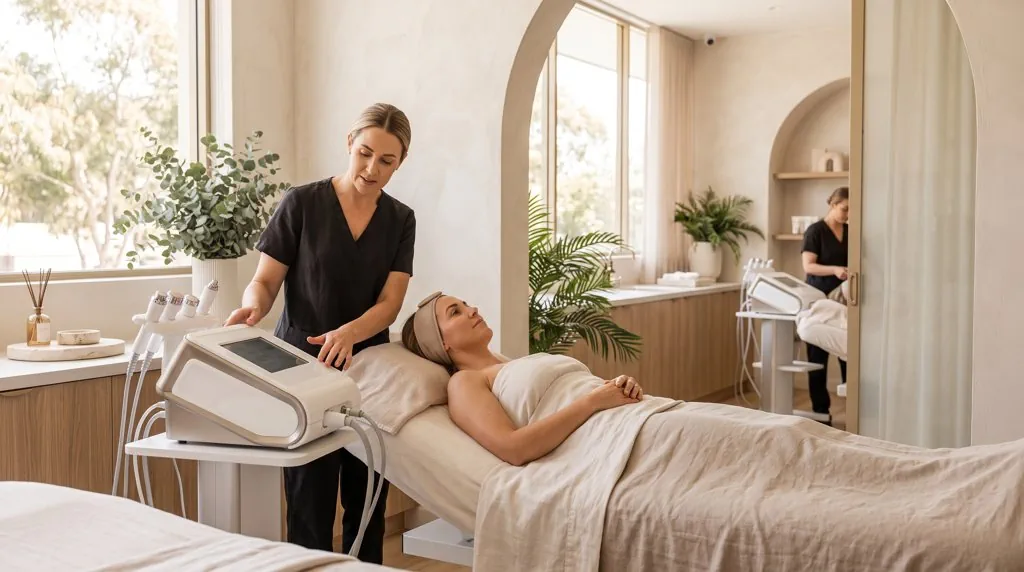
High-Margin Beauty Equipment Treatments: How to Choose Profitable Salon Technology
Beauty equipment is often sold to salon owners with an extremely attractive proposition.
Buy the machine. Add a premium treatment to the menu. Put the client on the device. Let the machine do most of the work. Generate more revenue without needing another therapist for every treatment minute.
Commercially, there can be something very powerful in that model.
A treatment that sells for $100 but requires only a relatively small amount of hands-on therapist time may have very different economics from a $100 service requiring a therapist’s undivided attention for the entire appointment.
But there is a dangerous leap between lower labour intensity and low monitoring.
No salon owner should assume that a client can be connected to a beauty device and left unattended simply because the treatment is marketed as automated, hands-free or passive.
The better business question is:
Which equipment-based services can produce strong revenue relative to the staff time, room time and operating cost required—while still being delivered safely, appropriately and professionally?
That is a much more useful way to think about beauty technology.
Don’t Buy a Machine Because the Supplier Says It Is Profitable
Beauty equipment sales presentations can make almost any machine look extraordinarily profitable.
A common calculation looks something like this:
Treatment price: $150
Consumable cost: $10
“Profit”: $140
Do 10 treatments a week and the machine supposedly generates $72,800 a year.
Except that $140 is not necessarily profit.
Someone still needs to consult with the client, prepare the treatment area, set up the device, deliver or supervise the treatment as required, clean and reprocess relevant equipment, document the service, turn over the room and handle the booking.
The business also has wages, superannuation, rent, electricity, merchant fees, insurance, marketing, maintenance, servicing, equipment depreciation and potentially finance repayments.
Then there is the biggest variable of all:
Will enough clients actually buy the treatment?
A machine does not create demand simply because it is sitting in your salon.
Before purchasing any device, build the business case using your own numbers rather than the supplier’s best-case scenario.
Measure Revenue Against Labour Minutes, Not Just Treatment Minutes
One of the most useful metrics for equipment-based services is revenue per active therapist minute.
Imagine two hypothetical treatments.
Treatment A sells for $150 and requires 60 minutes of continuous hands-on therapist time.
Treatment B also sells for $150, takes 45 minutes in the treatment room, but only requires 15 minutes of active therapist time because part of the protocol is appropriately device-led.
The two services have the same selling price and similar appointment duration, but they use labour differently.
That difference can be commercially valuable.
If the device’s instructions, treatment protocol, risk profile and your business procedures allow the therapist to undertake other appropriate productive work during part of the treatment, the business may gain leverage from the equipment.
But don’t automatically translate that into booking another treatment at the same time.
The therapist may still need to remain immediately available. They may need to observe the client periodically. The device may require specific supervision. The client’s response may change during treatment.
The amount of labour leverage available should therefore be established after you understand how the treatment must safely operate—not before.
“Hands-Free” Does Not Mean “Risk-Free”
This distinction deserves to become part of the beauty industry’s vocabulary.
A supplier may describe equipment as hands-free because the therapist does not physically manipulate the device throughout the entire treatment.
That does not necessarily mean the client should be left alone.
Ask much more specific questions.
What do the manufacturer’s instructions say about supervision? What adverse responses could occur? Can the client immediately alert a staff member? Does the device automatically stop under particular conditions? What pre-treatment screening is required? What observations need to be made during treatment? What training does the operator need? What does your insurer expect?
The answers may differ significantly between devices.
This is particularly important when comparing technologies. An LED treatment, body treatment system, automated facial device and laser are not interchangeable simply because all four use equipment.
Australia also does not have nationally uniform regulation for cosmetic laser, IPL and LED services. ARPANSA advises that cosmetic laser use is regulated in Queensland, Tasmania and Western Australia, while IPL is currently regulated in Tasmania; requirements differ between jurisdictions.
Equipment decisions therefore need to be based on the actual technology and where you operate.
Start With Treatments Your Clients Already Want
One of the biggest equipment-purchasing mistakes is beginning with the machine.
Start with the client.
Look at your consultation records, client requests, waiting lists and treatment history. What problems are clients already asking you to help with? Which existing treatments could be complemented by technology? Which clients would realistically purchase a course or repeat the service?
A salon with a large skin clientele may find that an appropriate device integrates naturally into existing treatment plans.
Another salon may buy exactly the same device and struggle to sell it because its clients primarily visit for lashes, brows and waxing.
The machine isn’t necessarily the problem.
The client base is different.
Before investing, test demand. Talk to existing clients. Review how often the relevant concern appears in consultations. Consider whether clients are already spending money on comparable services elsewhere.
“Trending on Instagram” is not demand analysis.
Look for Integration, Not Just Another Menu Item
The most valuable equipment often strengthens what the salon already does.
Instead of asking:
“What new machine treatment can we sell?”
ask:
“Where could appropriate technology improve or extend our existing client journey?”
Perhaps a device can be offered as a standalone service but also integrates into selected treatment plans. Perhaps it creates a maintenance option between higher-value appointments. Perhaps it supports a membership model or provides an add-on that uses relatively little additional active therapist time.
This can make the commercial case much stronger than relying entirely on acquiring new clients for one new machine.
It also makes staff conversations easier because therapists can recommend the service within a treatment strategy rather than feeling they suddenly need to “sell the machine”.
Technology should fit the treatment philosophy of the business.
The treatment menu should not be rebuilt around whatever equipment the owner purchased most recently.
Calculate the Real Treatment Contribution
Before purchasing a device, model the economics properly.
Start with the treatment selling price and subtract the costs directly associated with providing it. Depending on the service, that could include consumables, disposables, therapist labour, merchant fees and other variable costs.
Then consider the fixed and semi-fixed costs created by the machine itself: finance repayments, servicing, maintenance, replacement parts, calibration where relevant, insurance changes, staff training and eventual replacement.
Room utilisation matters too.
A service can require little therapist time while occupying a valuable treatment room for an hour. If that room could otherwise generate significantly more contribution from another treatment, the “passive” service may not be as profitable as it initially appears.
This is why salon owners should assess both labour productivity and room productivity.
A machine that frees a therapist but blocks your most valuable room may solve one capacity constraint while creating another.
A Simple Example
Suppose a device costs $24,000 and you expect to keep it for four years.
Ignoring finance costs for the moment, that is $6,000 per year of equipment cost before servicing, maintenance or consumables.
If the treatment contributes $60 after its direct delivery costs, you need 100 treatments a year simply to recover that $6,000 annual equipment cost.
But that still isn’t the whole story.
You need enough treatments to compensate for risk, training, marketing, downtime and the capital tied up in the purchase—and ultimately to generate an acceptable return.
Run conservative numbers.
If the investment only looks attractive when the machine is booked 30 hours a week from its first month, reconsider the assumptions.
Understand the Device Before You Understand the Finance
Commercial due diligence should never replace equipment due diligence.
Before purchasing, establish exactly what the device is, its intended purpose, who supplies it in Australia, what training is provided, what servicing is available and what evidence supports the claims being made about it.
Not every beauty device is automatically a medical device.
In Australia, whether equipment falls within medical-device regulation depends on factors including its intended purpose. Where a product is a medical device, the Therapeutic Goods Administration regulates its legal supply, subject to applicable exemptions or exclusions.
That also means beauty businesses need to be careful with treatment claims.
A device marketed for cosmetic appearance is not automatically something a salon can advertise as diagnosing or treating medical conditions.
The language used on your website, social media, consultation materials and treatment menu matters.
Do not simply copy dramatic claims from overseas supplier marketing.
Don’t Assume Overseas Compliance Means Australian Compliance
Beauty equipment is a global market.
A machine may carry overseas certification marks or be promoted as “FDA approved”, “CE certified”, “medical grade” or compliant with another international standard.
Those statements do not, by themselves, answer whether the product can legally be supplied or used as intended in Australia.
Australian requirements need to be considered separately.
Likewise, don’t assume that because another salon in your suburb uses the same machine, all compliance questions have been answered.
Before purchasing expensive equipment, ask the supplier for the Australian regulatory information relevant to that specific device and its intended use.
Where the device is represented as a medical device, understand its Australian regulatory status rather than relying on vague statements such as “TGA approved”.
The TGA itself cautions against claims implying TGA endorsement or approval in therapeutic-goods advertising.
Training Should Cover More Than Which Button to Press
A 30-minute equipment demonstration is not a complete training system.
Staff need to understand client selection, contraindications, precautions, treatment settings, safe operation, cleaning and infection-control procedures where relevant, expected responses, adverse events, emergency procedures, aftercare and when treatment should not proceed.
They should also understand what level of client monitoring is required.
If the machine has different settings, applicators or protocols, competency should reflect those differences.
Document who has been trained and what they have been assessed as competent to do.
If only three people in the business are competent to operate a device, everyone should know that.
A quiet Tuesday should not suddenly turn an untrained employee into the machine operator because a client wants an appointment.
Consider What Happens When Something Goes Wrong
Equipment sales discussions naturally focus on successful treatments.
Business owners should spend more time discussing unsuccessful ones.
What happens if the device stops working halfway through a treatment?
What if the client experiences unexpected pain?
What if there is a burn or other adverse response?
Who does the therapist call?
How quickly can the supplier provide technical support?
Does the business have an incident process?
Does the insurer need to be notified?
What records should be retained?
How long will repairs take?
Is a loan machine available?
A machine that generates $1,000 a week while functioning can become an expensive piece of furniture when a component fails and parts need to come from overseas.
Service support should therefore be part of the purchasing decision.
Ask where technicians are located, typical response times, what the warranty actually covers, whether travel is charged and how long critical replacement parts generally take to obtain.
Insurance Comes Before the Purchase Order
Before committing to a new device, contact your insurer.
Tell them exactly what equipment you intend to purchase and which treatments you intend to provide with it.
Ask whether your existing policy covers those services, whether there are training or qualification requirements, whether the device itself needs to meet particular conditions and whether your premium or excess will change.
Don’t assume:
“I’m insured as a beauty therapist, so every machine treatment I add must automatically be covered.”
That is a dangerous assumption.
Keep written confirmation where appropriate and update your insurer when the services or equipment used by the business materially change.
Our guide to Professional Indemnity Insurance for Beauty Therapists and Salons explains why treatment and equipment audits should form part of an annual insurance review.
Infection Control Still Applies to Machine-Based Services
A device-led treatment is still a treatment.
Reusable components, handpieces, applicators, goggles, straps, surfaces and other items may require cleaning, disinfection or other reprocessing according to their intended use, applicable infection-control requirements and manufacturer instructions.
Requirements can also differ according to the type of service and jurisdiction.
For example, Queensland’s current personal-appearance-services guidance requires reusable instruments and equipment used in those services to be appropriately reprocessed between clients and distinguishes between higher-risk and non-higher-risk services.
Do not let “automated” become synonymous with “low maintenance”.
The more frequently a machine is used, the more important consistent cleaning, maintenance and documentation can become.
Low-Labour Services Can Create New Capacity — If You Use It Properly
This is where the commercial opportunity becomes interesting.
If an appropriately selected device reduces active therapist time while maintaining safe and professional service delivery, ask what the released time can actually achieve.
Could the therapist complete consultation notes?
Prepare another treatment room?
Conduct an appropriate retail consultation?
Follow up clients?
Perform another compatible task while remaining available to monitor the device as required?
The answer will depend on the treatment.
Do not build a booking system where one therapist is supposedly supervising four different devices in four closed rooms simply because the spreadsheet makes the labour percentage look fantastic.
The goal is not to extract every possible minute from the therapist.
It is to increase productive capacity without compromising care.
Sometimes that means only gaining 15 productive minutes during a 45-minute treatment.
Across hundreds of treatments a year, those minutes can still be commercially meaningful.
Consider Add-Ons Before Standalone Treatments
Some equipment produces its strongest return as an enhancement to something clients already buy.
Imagine a service that takes 20 additional treatment minutes but requires only a few minutes of extra active therapist time and costs relatively little to deliver.
If appropriately integrated into an existing appointment, it may generate stronger incremental contribution than trying to build a completely separate appointment category around it.
This is why add-ons can be so valuable.
The client is already in the business. The consultation has already occurred. Some room turnover and acquisition costs are already absorbed by the primary service.
But an add-on should still have a genuine treatment rationale.
Don’t attach technology to every service simply because the machine needs to be paid off.
Recommendations should remain based on client suitability and treatment objectives.
Be Careful With “Unlimited” Device Memberships
Equipment treatments often appear attractive for membership models because the marginal consumable cost can look low.
That can tempt salons into selling unlimited access.
Think carefully.
Even where consumables are inexpensive, appointments still use room capacity, staff attention, equipment lifespan and booking availability.
High utilisation by a small number of members can change the economics very quickly.
If equipment treatments form part of a membership, model what happens when clients actually use the benefit frequently.
Our guide to Salon Membership Programs explains why memberships should be profitable when clients use their entitlements rather than relying on under-utilisation.
The ABA Beauty Equipment Business-Case Check
Before signing a finance agreement or paying a deposit, answer these questions:
- What genuine client problem will this device help us address?
- How many existing clients are realistic candidates?
- What evidence supports the treatment and claims?
- What is the device’s intended purpose?
- What Australian regulatory requirements apply to its supply and intended use?
- Are there state or territory licensing requirements relevant to the technology?
- What training and competency will operators need?
- What level of supervision or client monitoring is required?
- What does our insurer require?
- What is the total purchase or finance cost?
- What are the consumable costs per treatment?
- What are the servicing and maintenance costs?
- How much active therapist time does each treatment require?
- How much treatment-room time does it require?
- What contribution does each treatment actually generate?
- How many treatments are required to recover the investment?
- What happens if demand is half our forecast?
- What happens when the machine breaks down?
- How quickly can it be serviced in Australia?
- Does the treatment strengthen our existing business—or are we buying ourselves an entirely new business model?
If the supplier cannot help you answer the technical questions, and your own numbers cannot answer the commercial ones, you are not ready to purchase.
ABA Expert Tip: Calculate Profit Per Constrained Resource
Don’t just calculate revenue per treatment.
Ask what resource is most limited in your business.
Is it therapist time?
Treatment rooms?
Saturday appointments?
Qualified operators?
Equipment capacity?
Cash?
Then calculate how the proposed device affects that constraint.
A machine that saves therapist time is valuable when therapist capacity is your bottleneck.
It may be far less valuable if the real problem is that you only have two treatment rooms and both are already full.
The best equipment investment solves a real business constraint as well as a client need.
Common Equipment Investment Mistakes
The biggest mistake is buying equipment because the projected treatment margin looks impressive without testing whether client demand exists.
Another is confusing treatment price minus consumables with profit. Labour, room capacity, servicing, finance and overhead still matter.
Don’t accept “hands-free” as a complete answer to supervision. Ask exactly what monitoring the manufacturer, insurer and relevant professional or regulatory requirements expect.
Avoid relying entirely on supplier training without establishing your own competency standards. Avoid making medical-style treatment claims simply because competitors use them. And don’t assume an overseas certification mark automatically answers Australian regulatory questions.
Finally, don’t let sunk-cost thinking drive treatment recommendations.
Once an expensive machine arrives, owners naturally want it used.
That should never become pressure on therapists to recommend the device to unsuitable clients simply because repayments are due.
The machine serves the treatment plan.
The treatment plan does not serve the machine.
Frequently Asked Questions
What is a low-labour beauty treatment?
It is a service where an appropriate device or process reduces the amount of continuous hands-on therapist time required. It does not necessarily mean the client can be left unattended.
Can I leave a client alone while a beauty machine is operating?
Do not apply a blanket rule. Appropriate supervision depends on the specific device, manufacturer instructions, treatment protocol, client, risk profile, insurer requirements and any applicable regulation.
Are all beauty machines medical devices?
No. Whether a product is regulated as a medical device in Australia depends on matters including its intended purpose. Where a product is a medical device, TGA requirements can apply.
Does every beauty device need to be TGA registered?
No blanket statement should be made that every piece of beauty equipment requires ARTG inclusion. Medical devices generally need to be included in the Australian Register of Therapeutic Goods unless an exemption or exclusion applies, but not every beauty device is necessarily a medical device.
Is LED regulated in Australia?
ARPANSA states there are currently no nationally uniform laws regulating who may deliver cosmetic laser, IPL and LED phototherapy. Cosmetic laser is regulated in Queensland, Tasmania and Western Australia, IPL is regulated in Tasmania, and ARPANSA reports no radiation regulatory oversight for LED phototherapy. Businesses must still consider other applicable laws, safety duties and professional requirements.
What should I ask my insurer before buying a machine?
Provide the exact device and intended treatments and ask whether they are covered, what qualifications or training are required, whether any exclusions apply and whether your policy needs to be amended.
How do I calculate whether a machine will be profitable?
Model treatment price, realistic demand, active labour, consumables, room time, servicing, insurance, finance, maintenance, marketing and equipment life. Then test the model using conservative booking volumes.
Is a hands-free treatment automatically more profitable?
No. It may reduce active labour but still occupy treatment-room capacity, require supervision and carry significant equipment costs.
Should I finance beauty equipment?
Finance can preserve cash but creates an ongoing obligation whether the machine is busy or not. Compare the total financing cost with realistic treatment contribution and conservative demand forecasts before committing.
Should equipment treatments be included in memberships?
They can be, but model utilisation carefully. Low consumable cost does not mean zero delivery cost or unlimited capacity.
Useful Australian Resources
For light-based cosmetic treatments, the Australian Radiation Protection and Nuclear Safety Agency provides guidance on lasers, IPL and LED phototherapy, including current information about differences in state and territory regulation.
For equipment represented as a medical device, use the Therapeutic Goods Administration to understand Australian medical-device requirements and the importance of intended purpose.
Beauty businesses should also check the health, radiation and workplace-safety requirements applying in their own state or territory rather than assuming there is one national rule covering every beauty device.
Final Thoughts
Beauty technology can create extraordinary opportunities for salons and clinics.
The right device can expand treatment capability, improve client experience, create valuable add-ons and allow a business to generate more revenue without increasing hands-on labour at exactly the same rate.
That is real operational leverage.
But the opportunity is not to find machines that allow you to stop paying attention to clients.
It is to find technology that uses professional time more efficiently while maintaining appropriate care, supervision and safety.
Start with client demand. Understand the technology. Check the Australian requirements. Speak to your insurer. Train the team properly. Calculate labour and room productivity. Stress-test the numbers. Investigate servicing before something breaks.
Then ask the question every equipment supplier should expect a serious salon owner to ask:
“Show me how this makes money using realistic utilisation—not the best-case scenario.”
Because the most profitable machine in your salon will not necessarily be the one with the highest treatment price or the lowest consumable cost.
It will be the one that clients genuinely want, your team can deliver appropriately, your business can support safely and your numbers prove deserves its place in the treatment room.
This article provides general business and industry information only and is not legal, regulatory, clinical, financial or work health and safety advice. Requirements can differ according to the equipment, intended purpose, treatment and Australian jurisdiction. Businesses should verify current requirements with relevant regulators, insurers, manufacturers and appropriately qualified advisers.

