How to Create a Professional Hands-On Beauty Course and Prepare It for CPD Accreditation
How to Create a Professional Hands-On Beauty Course and Prepare It for CPD Accreditation
Creating a hands-on beauty course involves more than demonstrating a treatment and allowing students to practise it.
A well-structured practical course should combine relevant theory, trainer demonstration, supervised student practice and appropriate assessment. Students should understand not only how to perform the procedure, but also the client-suitability considerations, contraindications, hygiene requirements, potential risks and professional responsibilities relevant to the treatment.
If you are developing face-to-face beauty or wellness training and intend to submit it for accreditation, planning the educational and practical structure before submission can make the review process considerably easier.
This guide explains how to structure hands-on beauty training and prepare it for Australian Beauty Association (ABA) Hands-On Beauty Course Accreditation.
Learn More About ABA CPD Course Accreditation
What Is a Hands-On Beauty Course?
A hands-on course is practical education in which students learn skills through a combination of instruction, demonstration and supervised practice.
Depending on the subject, a course may include:
- Pre-course theory
- Classroom theory
- Trainer demonstrations
- Practical exercises
- Supervised student practice
- Practice on models where appropriate
- Knowledge assessment
- Practical assessment
- Case studies where applicable
- Supporting educational resources
The appropriate structure will vary according to the treatment, complexity of the skills, intended audience and learning outcomes.
There is no single course format suitable for every beauty treatment.
Start With Clear Learning Outcomes
Before deciding how long the course should be or how the practical day will operate, establish what students are expected to learn.
Learning outcomes should describe realistic knowledge or skills addressed by the course.
For example:
By the end of the course, students should be able to:
- Explain the basic principles of the treatment
- Identify relevant client-suitability considerations, contraindications and precautions
- Describe appropriate hygiene and infection-control procedures
- Prepare relevant products and equipment
- Follow the treatment procedure taught within the course
- Recognise relevant expected treatment responses and potential adverse responses
- Explain appropriate client aftercare
- Complete the provider’s required knowledge and practical assessments
Avoid making learning outcomes broader than the education actually provided.
Completing a short course should not automatically be represented as making a person qualified, licensed, insured or legally authorised to provide a treatment where separate requirements may apply.
Build the Course Around the Learning Outcomes
Once you know what students need to learn, build the education around those outcomes.
A practical treatment course might follow a structure such as:
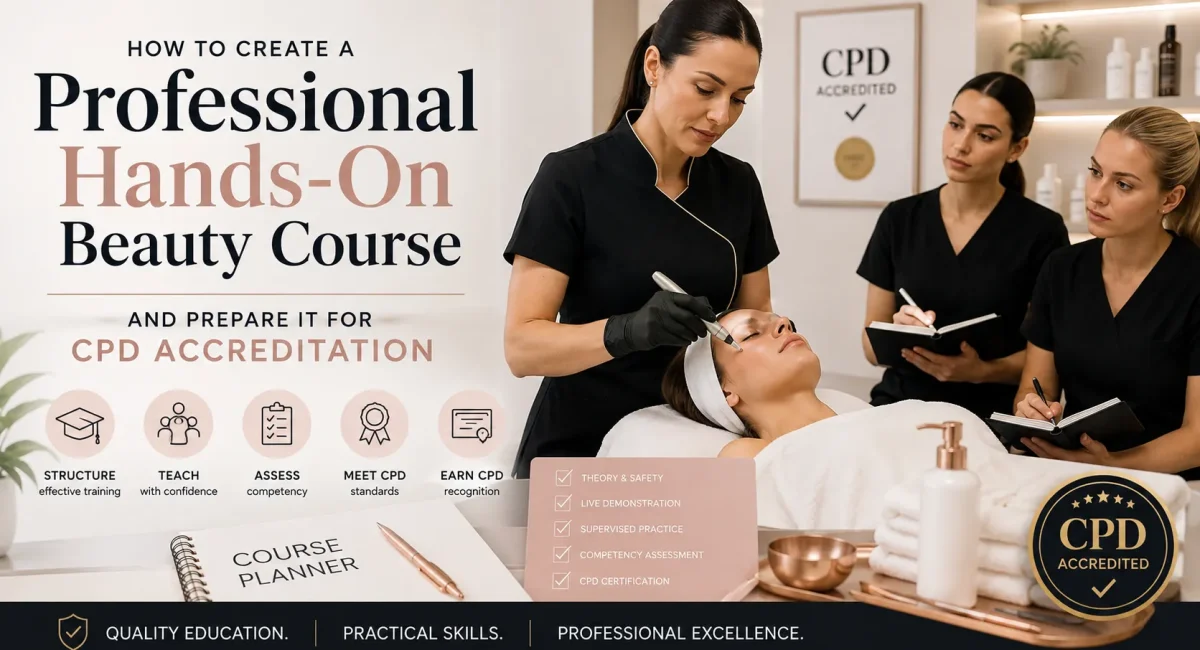
Theory → Trainer Demonstration → Supervised Student Practice → Assessment → Course Completion
For some treatments, additional case studies or post-course evidence may also be appropriate.
The course structure should reflect the subject being taught rather than following a standard template simply because another beauty course uses it.
Provide Appropriate Theory
Hands-on training should generally be supported by enough theory for students to understand the practical activities they are undertaking.
Depending on the treatment, this may include:
- Relevant anatomy and physiology
- Treatment principles
- Client consultation
- Contraindications and precautions
- Hygiene and infection control
- Products and equipment
- Treatment preparation
- Treatment procedure
- Treatment parameters where applicable
- Potential risks and adverse reactions
- Troubleshooting
- Aftercare
The theory should be relevant to the course.
More information does not automatically mean better education.
Provide Students With a Training Manual
Students undertaking hands-on education should have access to appropriate educational material supporting the training they receive.
A student training manual may provide a reference they can revisit before, during and after the practical education.
Depending on the subject, it may contain:
- Learning objectives
- Treatment theory
- Relevant anatomy and physiology
- Consultation
- Contraindications
- Hygiene
- Treatment preparation
- Products and equipment
- Step-by-step procedures
- Potential risks
- Troubleshooting
- Aftercare
- Supporting forms and resources
For ABA Hands-On Beauty Course Accreditation, review and accreditation of the student training manual submitted as part of the course is included within the Hands-On Course Accreditation fee.
You do not need to purchase separate ABA Beauty Manual Accreditation for the same manual.
Client Consultation
For treatment-based courses, students may need to understand how client information can affect treatment decisions.
Relevant education may include:
- Client history
- Previous treatments
- Relevant medications or products
- Allergies
- Current treatment-area condition
- Contraindications
- Precautions
- Treatment expectations
- Consent
- Record keeping
Consultation should not be taught simply as completing a form.
Where relevant, students should understand why information is collected and how it may affect the treatment decision.
Contraindications and Precautions
Contraindications should be relevant to the treatment being taught.
Where appropriate, the course may explain circumstances in which treatment:
- Should not proceed
- Should be postponed
- May need modification
- Requires additional caution
- May require the client to seek appropriate medical advice or referral
Where useful, explain why an important contraindication matters.
Students should not be encouraged to diagnose medical conditions or work outside the appropriate scope of the treatment education they have received.
Hygiene and Infection Control
Practical training should demonstrate the hygiene and infection-control procedures relevant to the treatment being taught.
Depending on the service, this may include:
- Hand hygiene
- PPE
- Cleaning
- Disinfection
- Single-use items
- Cross-contamination prevention
- Linen handling
- Waste management
- Product handling
- Equipment cleaning
- Treatment-area preparation
Students should see these procedures incorporated into the practical training rather than learning hygiene only as separate theory.
Products and Equipment
Where products or equipment are required, students should understand their relevant purpose and use.
This may include:
- Required products
- Required consumables
- Equipment
- Applicators or handpieces
- Product preparation
- Equipment preparation
- Cleaning
- Maintenance
- Storage
- Relevant safety features
For equipment-based treatments, students may also need education regarding relevant controls and treatment parameters.
Manufacturer instructions should be followed where applicable.
Generic course material should not be presented as replacing the instructions applicable to a particular device or product.
Be Careful With Treatment Parameters
Treatment parameters require particular care in equipment-based education.
Settings can vary between devices, manufacturers and treatment systems.
Avoid teaching one universal setting as appropriate for every device or client unless that statement can genuinely be supported.
Where relevant, students should understand the importance of:
- The specific equipment being used
- Applicable manufacturer instructions
- Relevant client factors
- Treatment-area considerations
- Treatment response
- Applicable safety requirements
If your course is specifically designed for one piece of equipment, ensure the educational material is consistent with the current information applicable to that equipment.
Structure the Trainer Demonstration
A practical demonstration should involve more than students simply watching the trainer perform the procedure.
Consider how the trainer will explain:
- Preparation
- Client positioning
- Product or equipment setup
- Relevant safety checks
- Treatment sequence
- Technique
- Common errors
- Client communication
- Expected treatment responses
- When treatment should be stopped
- Treatment completion
- Aftercare
- Cleaning and disinfection
Students should have an opportunity to observe the procedure clearly and ask relevant questions.
Supervised Student Practice
Where practical skills form part of the stated learning outcomes, students should have an appropriate opportunity to practise those skills.
Supervised practice allows the trainer to:
- Observe technique
- Correct errors
- Answer questions
- Reinforce safety procedures
- Provide feedback
- Observe the student’s application of the procedure
The amount of practice required will vary considerably between courses.
A relatively straightforward beauty service and a more complex equipment-based treatment should not automatically have identical practical-training requirements.
Class Size and Student-to-Trainer Ratio
There is no single class size or student-to-trainer ratio appropriate for every hands-on beauty course.
Consider factors including:
- Complexity of the treatment
- Nature of the practical skills
- Previous experience required
- Number of trainers
- Number of students
- Number of treatment stations
- Equipment availability
- Model availability
- Amount of supervision required
- Practical assessment requirements
The proposed class structure should allow the trainer to provide the supervision and assessment described within the course.
Course providers remain responsible for determining an appropriate and safe class size for their particular training environment.
Training With Models
Where students practise on models or clients, appropriate procedures should be established.
Depending on the treatment, these may include:
- Model suitability requirements
- Consultation
- Contraindication screening
- Consent
- Explanation that treatment may be performed by a student
- Treatment records
- Photography consent where applicable
- Aftercare
- Procedures for unexpected treatment responses
The course should also consider what happens if a model is unsuitable for treatment or becomes unable to participate.
The course provider remains responsible for determining and complying with any legal, insurance, workplace health and safety or other requirements applicable to practical training involving models.
Create an Appropriate Knowledge Assessment
Practical ability may need to be supported by relevant theoretical understanding.
Depending on the course, a knowledge assessment may cover:
- Treatment theory
- Client suitability
- Contraindications
- Hygiene
- Treatment safety
- Potential risks
- Adverse reactions
- Treatment parameters where applicable
- Aftercare
Assessment should relate to the stated learning outcomes and material students have been taught.
Assessment methods might include:
- Multiple-choice questions
- Scenario-based questions
- Written questions
- Consultation scenarios
- Treatment-planning activities
Avoid making every incorrect option obviously wrong.
Well-designed scenario questions can be useful for assessing whether students understand how course information applies to realistic situations.
Practical Assessment
If successful completion of the course requires students to demonstrate practical skills, the provider should establish an appropriate assessment process.
Depending on the treatment, a practical assessment checklist might consider:
- Client consultation
- Identification of relevant contraindications
- Hygiene procedures
- Treatment preparation
- Client positioning
- Product preparation
- Equipment handling
- Treatment technique
- Treatment sequence
- Client communication
- Treatment safety
- Recognition of unexpected responses
- Treatment completion
- Aftercare
- Cleaning and disinfection
- Professional documentation
Assessment criteria should relate to the learning outcomes and practical skills actually taught.
Who Determines Student Competency?
This distinction is important.
The course provider and its trainers are responsible for assessing individual students and determining whether they have satisfied the provider’s course completion and practical assessment requirements.
ABA reviews the assessment framework submitted as part of the accreditation application.
ABA course accreditation does not mean ABA has personally observed, assessed or certified the practical competency of each student or graduate.
Course providers should therefore not represent ABA accreditation as individual ABA certification of a graduate’s practical competency.
What Happens If a Student Does Not Meet the Course Assessment Requirements?
Your course should explain what happens when a student does not initially satisfy the provider’s stated assessment requirements.
This may include:
- Additional practice
- Trainer feedback
- Further education
- Reassessment
- Additional evidence
- Case studies where applicable
The process should be clearly communicated to students.
A certificate indicating successful completion should only be issued when the student has met the completion requirements established for that course.
Should You Require Case Studies?
Case studies may be useful for some courses but are not automatically required for every hands-on beauty course.
Depending on the treatment and learning outcomes, a provider may choose to require additional post-course evidence.
This might include:
- Consultation records
- Treatment plans
- Before-and-after photographs
- Treatment parameters
- Product or equipment selection
- Treatment records
- Aftercare
- Student reflection
If case studies are required, explain:
- How many are required
- What evidence students need to provide
- When they must be submitted
- How they will be assessed
- What happens if further evidence is required
Consider the Training Environment
The practical training environment should be appropriate for the activities being delivered.
Depending on the treatment, consider:
- Treatment space
- Lighting
- Ventilation
- Handwashing facilities
- Cleaning facilities
- Waste management
- Electrical safety
- Treatment beds or chairs
- Equipment placement
- Student movement
- Model privacy
- Emergency procedures
Course providers remain responsible for determining and complying with applicable workplace health and safety, premises, electrical, infection-control and other requirements.
ABA course accreditation should not be represented as approval or certification of the provider’s premises.
Trainer Knowledge and Experience
The trainer plays an important role in the delivery of practical education.
Providers should consider whether trainers have appropriate knowledge and experience relevant to the subject they are teaching.
Depending on the course, relevant evidence might include:
- Beauty or wellness qualifications
- Treatment-specific education
- Equipment-specific training
- Industry experience
- Practical treatment experience
- Teaching or training qualifications where held
- Experience delivering education
Providers remain responsible for ensuring trainers meet any qualification, experience, insurance, legal or other requirements applicable to their activities.
Where trainer information is considered during an ABA accreditation review, this does not constitute separate ABA certification, registration, licensing or endorsement of the individual trainer.
Create a Trainer Guide or Lesson Plan
A trainer guide can help ensure the course is delivered consistently.
It may include:
- Course timetable
- Learning outcomes
- Theory topics
- Demonstration sequence
- Practical exercises
- Breaks
- Model requirements
- Assessment procedures
- Required resources
- Completion requirements
This can be particularly useful where more than one trainer delivers the same course.
Calculate Course Duration Realistically
Course duration should reflect the genuine time reasonably required to complete the compulsory education and assessment.
This may include:
- Required pre-course theory
- Classroom theory
- Demonstrations
- Supervised practice
- Learning activities
- Knowledge assessment
- Practical assessment
- Required case studies
Avoid increasing course duration simply to obtain a larger CPD allocation.
Registration, lunch breaks, social activities and unrelated activities should not be counted as educational time.
How Are CPD Credits Determined?
Where applicable, an approved course may be allocated Continuing Professional Development (CPD) credits based on its educational content and the reasonable time required to complete compulsory learning activities.
CPD allocation is determined as part of the accreditation review.
Purchasing accreditation does not guarantee approval or a predetermined number of CPD credits.
What Is ABA Hands-On Beauty Course Accreditation?
ABA Hands-On Beauty Course Accreditation is an independent professional accreditation service for eligible continuing professional development education.
ABA reviews the submitted:
- Course materials
- Learning outcomes
- Educational content
- Student training manual
- Proposed practical training structure
- Assessment framework
- Supporting documentation
against the applicable ABA accreditation requirements.
The exact requirements depend on the subject and scope of the course being submitted.
What Happens During Accreditation?
The general process is:
Submit → Review → Feedback/Amendments if Required → Accreditation Decision
If further information or amendments are required, the provider will be advised.
These may relate to matters such as:
- Missing educational content
- Safety information
- Learning outcomes
- Contraindications
- Practical training structure
- Assessment
- Student resources
- Trainer information
- Certification wording
An amendment request forms part of the accreditation review and does not constitute approval.
Purchasing the accreditation service does not guarantee accreditation.
Accreditation Provides an Independent Review Step
The ABA accreditation process involves review of the submitted course materials and proposed training and assessment framework against the applicable ABA accreditation requirements.
Where issues are identified, providers may be asked to clarify or amend the submitted material before an accreditation decision is made.
This external review is separate from the provider’s own course-development process.
It does not transfer responsibility for the course, its delivery or its students from the provider to ABA.
Accreditation Is Valid for 12 Months
ABA Hands-On Beauty Course Accreditation is valid for 12 months from the date of approval.
Accreditation may be renewed subject to the ABA requirements and review process applicable at the time of renewal.
Course providers remain responsible for maintaining their educational material throughout the accreditation period.
This is particularly important when changes occur to:
- Treatment protocols
- Contraindications
- Safety information
- Infection-control guidance
- Equipment
- Products
- Manufacturer instructions
- Legislation or regulation
- Professional guidance
Significant changes to an accredited course may require further review.
CPD Accreditation Is Not a VET Qualification
ABA CPD accreditation applies to eligible professional-development education submitted and approved through the applicable ABA accreditation review process.
It does not automatically turn a short beauty course into a nationally recognised Australian vocational education and training qualification.
ABA accreditation does not make the education provider a Registered Training Organisation (RTO).
Course providers should not describe an ABA-accredited course as a Certificate III, Certificate IV, Diploma or other nationally recognised VET qualification unless that qualification is legitimately delivered within the applicable Australian VET framework.
Understanding the Scope of ABA Hands-On Course Accreditation
It is important to understand exactly what ABA accreditation represents.
ABA Hands-On Beauty Course Accreditation applies to the course materials, proposed training framework and assessment process submitted to ABA for review.
ABA accreditation does not:
- Make the course a nationally recognised Australian VET qualification
- Make the provider a Registered Training Organisation (RTO)
- Constitute government accreditation, licensing or government approval
- Grant a student or graduate legal authority, registration or a licence to perform a treatment
- Constitute individual ABA certification of each student’s or graduate’s practical competency
- Replace qualifications, licences, registrations, permits, supervision or other requirements that may apply
- Guarantee insurance or acceptance by an insurer
- Guarantee acceptance by an employer, regulator, professional association or other third party
- Guarantee employment, business or commercial outcomes
The course provider remains responsible for the course, its delivery and determining the requirements applicable to its particular activities.
Insurance and ABA Accreditation
ABA accreditation does not constitute insurance approval and does not guarantee that a course provider, trainer, student or graduate will be accepted for insurance.
Insurance requirements vary between insurers, policies, treatments and individual circumstances.
Providers, trainers and students should make their own enquiries with the relevant insurer or insurance adviser regarding the qualifications, training, treatments and other requirements applicable to the insurance cover they require.
Accreditation Does Not Authorise a Treatment
Completing an ABA-accredited course does not, by itself, establish that a person is legally permitted, appropriately qualified or insured to perform every treatment covered by that course.
Requirements can vary depending on factors such as:
- The treatment
- Equipment
- Products
- Location or jurisdiction
- Existing qualifications or registration
- Workplace requirements
- Insurance
- Manufacturer requirements
Course providers and students remain responsible for determining the requirements applicable to their circumstances.
Provider Responsibilities
Accreditation relates to the course materials and training framework submitted to ABA for review.
The course provider remains responsible for matters including, where applicable:
- Accuracy and currency of course content
- Course delivery
- Trainer selection and suitability
- Student supervision
- Student assessment
- Practical training activities
- Model and client safety
- Compliance with applicable laws and regulations
- Insurance
- Equipment and product use
- Manufacturer requirements
- Advertising and representations
- Intellectual property and permissions
- Student support
- Record keeping
- Applicable licences, registrations, permits or other requirements
ABA accreditation should not be used to imply ABA approval of matters outside the scope of the accreditation review.
Using AI When Developing Your Course
AI tools can be useful when creating course materials.
They may assist with:
- Course structure
- Lesson planning
- Improving explanations
- Assessment ideas
- Student resources
- Editing and proofreading
However, AI-generated information can be incorrect, outdated or inappropriate for a particular treatment.
Course providers should independently verify important technical and safety information.
Particular care should be taken with:
- Anatomy
- Contraindications
- Medical terminology
- Treatment parameters
- Equipment specifications
- Infection control
- Legislation
- Treatment claims
The course provider remains responsible for verifying the accuracy, currency and appropriateness of the education it delivers. Accreditation does not transfer that responsibility to ABA.
Before Submitting Your Hands-On Course
Before lodging your course for accreditation, check that you have:
- Clear learning outcomes
- Appropriate theory
- Relevant trainer information
- A completed student training manual
- Contraindications and precautions where applicable
- Hygiene and safety education
- A structured trainer demonstration
- Appropriate supervised-practice arrangements
- Appropriate class and supervision arrangements
- Model procedures where applicable
- Knowledge assessment
- Practical assessment criteria
- Case-study requirements where applicable
- Clear completion requirements
- Proposed student certification
- Relevant supporting documentation
Using a structured checklist before submission can help identify missing information before the accreditation review begins.
Well-Structured Training Supports Professional Development
A well-structured hands-on course can combine relevant theory, trainer demonstration, supervised practice and assessment within a logical educational framework.
The exact structure should reflect the treatment, learning outcomes and intended students rather than simply copying the format of another course.
Independent accreditation provides an additional review step by having the submitted course assessed against the applicable ABA accreditation requirements.
The provider remains responsible for delivering the training, supervising students, conducting assessments and maintaining the course after accreditation.
Ready to Submit Your Hands-On Beauty Course?
The Australian Beauty Association provides accreditation services for eligible beauty and wellness education submitted for independent review against the applicable ABA accreditation requirements.
Hands-On Course Accreditation includes review and accreditation of the student training manual supplied as part of the submitted course, so separate ABA Manual Accreditation is not required for the same resource.
Accreditation is valid for 12 months from the date of approval and is subject to the applicable ABA accreditation conditions.
ABA Hands-On Beauty Course Accreditation – 1 Year
For education delivered completely online:
ABA Online Beauty Course Accreditation – 1 Year
For a standalone training manual or educational resource: